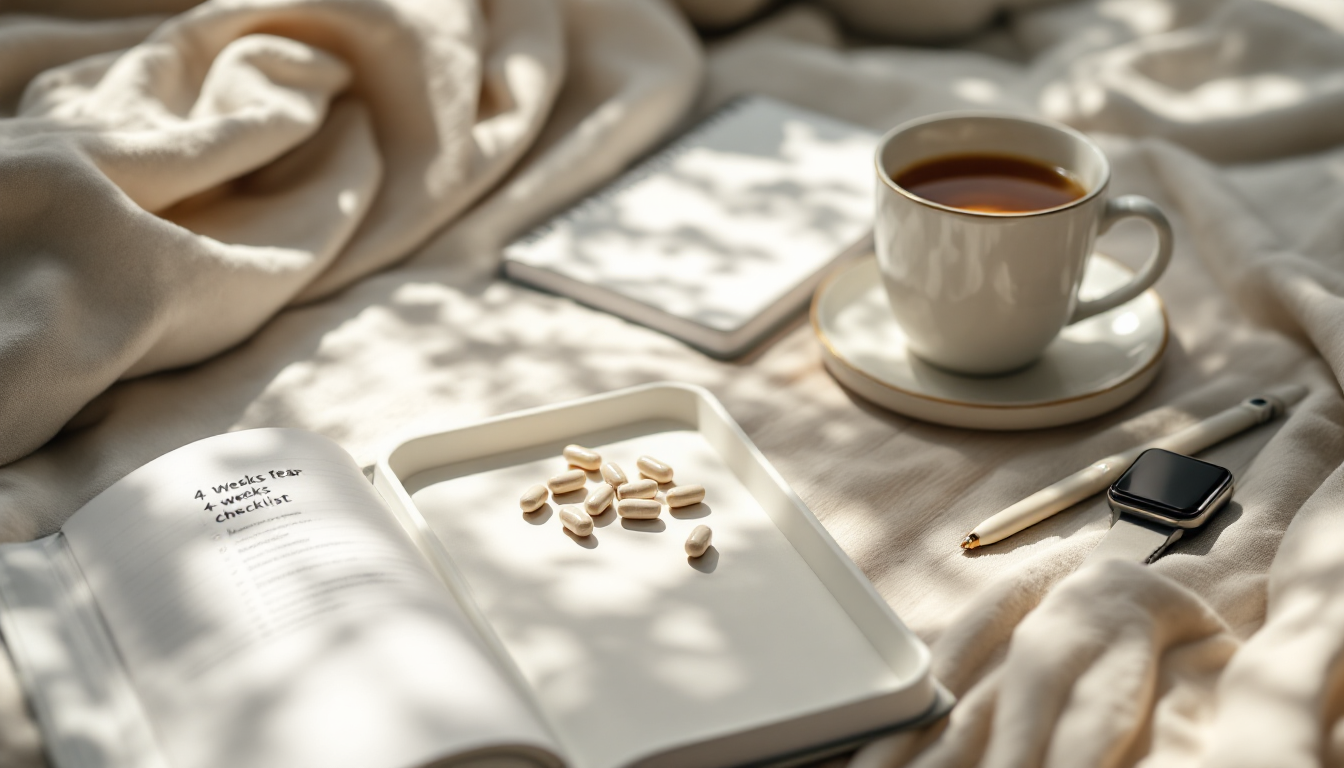
Want to improve your sleep consistently over 4 weeks without benzodiazepines or prescription hypnotics? This protocol mixes circadian habits, a repeatable pre‑sleep routine, environmental tweaks and a conservative supplement triad — low‑dose melatonin, magnesium glycinate and L‑theanine — with simple metrics so you can measure progress. The approach favours realistic gains and low risk, and includes alternatives for late‑evening training, jet lag and shift work.
How to measure progress: 3 simple metrics (and baseline)
Before changing anything, record a 3‑day baseline using a simple sleep diary (paper or app). I use a condensed version of the Consensus Sleep Diary.
- Sleep onset latency (SOL): minutes from lights‑out to sleep. Realistic target: < 20–25 min; a 20–30% reduction in 4 weeks is a solid win. (pmc.ncbi.nlm.nih.gov)
- Number of awakenings: times you wake and stay awake > 2–3 min.
- Morning feeling (1–5): 1=very bad, 5=very good; aim to increase ≥1 point after 4 weeks.
Light supplementation: what, typical dose and when to take
| Supplement | Purpose | Typical dose | When | Important notes |
|---|---|---|---|---|
| **Melatonin (low dose)** | Circadian adjustment and sleep latency | 0.3–1 mg (start 0.3–0.5 mg) | 30–90 min before bedtime | Modest improvement in latency; useful for jet lag. Avoid chronic high doses. ([pmc.ncbi.nlm.nih.gov](https://pmc.ncbi.nlm.nih.gov/articles/PMC3656905/?utm_source=openai)) |
| **Magnesium glycinate** | Relaxation and reducing sleep complaints | 100–200 mg elemental magnesium | 1–2 h before bedtime | Emerging evidence (better if deficient); glycinate tends to be well tolerated. ([pmc.ncbi.nlm.nih.gov](https://pmc.ncbi.nlm.nih.gov/articles/PMC12412596/?utm_source=openai)) |
| **L‑theanine** | Reduce pre‑sleep anxiety; support relaxation | 200 mg | 30–60 min before bedtime | Positive but heterogeneous results; good safety profile. ([pubmed.ncbi.nlm.nih.gov](https://pubmed.ncbi.nlm.nih.gov/40056718/?utm_source=openai)) |
Week 1 — Align the internal clock (light, caffeine and schedules)
- Morning light: 20–30 min of outdoor light (ideally sunlight) within 2 hours after waking. Morning light advances the clock and improves nighttime sleepiness. (pmc.ncbi.nlm.nih.gov)
- Dim the evening: lower indoor lighting 2–3 hours before bed; use night‑shift filters or blue‑blocking glasses if you use screens. Short‑wavelength light at night suppresses melatonin and delays sleepiness. (doi.org)
- Cut caffeine: avoid caffeine in the 6–8 hours before bedtime. Even 400 mg consumed 6 hours prior reduces total sleep time and worsens latency. (pmc.ncbi.nlm.nih.gov)
- Alcohol and nicotine: avoid alcohol 3–4 hours before bed; limit nicotine in the evening — both fragment sleep. (sleepfoundation.org)
- Consistent schedule: pick a fixed wake time (±15 min) every day; don’t “pay back” with long lie‑ins. (aasm.org)
Week 2 — Bedroom and pre‑sleep routine that actually work
- Temperature: keep the bedroom cool, typically 60–67°F (16–19°C); adjust bedding to personal comfort. (health.clevelandclinic.org)
- Dark and quiet: blackout curtains + earplugs or white noise. Reducing blue light in the bedroom helps sleep consolidation. (archive.cdc.gov)
- Meals and fluids: finish large meals 2–3 h before bed; moderate late fluids to avoid bathroom trips. (thensf.org)
- 30–60 min wind‑down: fixed routine (dim lights, warm shower, paper book, light stretching, 4‑7‑8 breathing or progressive relaxation). (pmc.ncbi.nlm.nih.gov)
- Stimulus control: use the bed only for sleep and sex. If you can’t sleep in ~20 min, get up for a calm activity in low light and return when sleepy. (aasm.org)
Week 3 — Introduce the supplement triad (use minimum effective dose)
If weeks 1–2 already reduced latency and awakenings, you may not need supplements. If symptoms persist, introduce one supplement at a time in the order below, waiting 7 days before adding the next.
Step 1: Melatonin (0.3–0.5 mg)
- Take 30–60 min before planned bedtime for 7 nights. If no benefit, you may test up to 1 mg. (pubmed.ncbi.nlm.nih.gov)
- Expect a modest reduction in latency (usually minutes); effect is larger when there’s a circadian component (e.g., habitual late bedtimes) or jet lag. (pmc.ncbi.nlm.nih.gov)
Step 2: Magnesium glycinate (100–200 mg elemental Mg)
- Take 1–2 hours before bed. If you’re prone to loose stools, start at 100 mg. (pmc.ncbi.nlm.nih.gov)
- Recent trials with bisglycinate and similar forms show small but meaningful improvements in people with sleep complaints; effects are larger if deficiency exists. (pmc.ncbi.nlm.nih.gov)
Step 3: L‑theanine (200 mg)
- Use 30–60 min before bed, especially when the mind races at night. (academic.oup.com)
- Meta‑analyses show benefits for sleep and anxiety but with study heterogeneity; keep expectations realistic. (pubmed.ncbi.nlm.nih.gov)
Week 4 — Fine tuning and special cases
Mild to moderate insomnia (no jet lag)
- Double down on stimulus control and sleep restriction (time in bed ≈ average TST; adjust by ~15 min/week depending on sleep efficiency). These techniques are pillars of CBT‑I. (pmc.ncbi.nlm.nih.gov)
- Maintain daily morning light and a consistent ‘night environment’. (pmc.ncbi.nlm.nih.gov)
Jet lag: a quick and safe adjustment
- Traveling east (advance): seek morning light at destination and avoid strong evening light for the first days. Reverse for westbound travel. (pmc.ncbi.nlm.nih.gov)
- Melatonin 0.5–1 mg at local bedtime for 2–4 nights reduces jet‑lag symptoms. Doses from 0.5–5 mg have been used; start low. (pmc.ncbi.nlm.nih.gov)
If you train late in the day
- Current evidence suggests evening exercise, even within 4 hours of bedtime, does not harm sleep for most adults and can increase deep sleep — provided you allow time to cool down. (pubmed.ncbi.nlm.nih.gov)
- Plan to finish ≥90 min before bed, include a cool‑down, warm shower and a light carb + protein snack. (pubmed.ncbi.nlm.nih.gov)
If you work shifts (night/rotating)
- Use bright light during the start of the shift and keep the bedroom dark for daytime sleep (use sunglasses on the trip home + blackout). (cdc.gov)
- Consider melatonin before daytime sleep to improve duration/quality (AASM conditional recommendation). (aasm.org)
- Strategic caffeine early in the shift helps alertness; avoid it in the 5–6 hours before planned sleep. Planned short naps can help. (cdc.gov)
Daily and weekly checklists
Daily checklist (tick ✓)
- Outdoor light 20–30 min in the morning (✓/✗). (pmc.ncbi.nlm.nih.gov)
- No caffeine in the last 6–8 h (✓/✗). (pmc.ncbi.nlm.nih.gov)
- Finished dinner ≥3 h before bed (✓/✗). (thensf.org)
- 30–60 min pre‑sleep routine with dim lights (✓/✗). (pmc.ncbi.nlm.nih.gov)
- Bedroom 60–67°F (16–19°C), dark and quiet (✓/✗). (health.clevelandclinic.org)
- If >20 min unable to sleep: get out of bed (✓/✗). (aasm.org)
Weekly checklist (Sunday evening)
- Has average SOL dropped ≥10–20% vs. baseline?
- Awakenings decreased or become shorter?
- Morning feeling increased ≥1 point?
- If you used supplements: did any show clear benefit? Keep only what helps at the lowest effective dose.
Troubleshooting common problems
Always waking at 3–4 AM
Keep ambient light very low when you get up to use the bathroom; avoid looking at screens. If you can’t fall back asleep in ~20 min, use stimulus control. Check late alcohol and caffeine — common causes of fragmentation. (sleepfoundation.org)
It takes me 40–60 min to “switch off”
Prioritise morning light, strict blue‑light avoidance at night, and a fixed wind‑down routine. Consider L‑theanine 200 mg 30–60 min before bed for 10–14 days and reassess. (pubmed.ncbi.nlm.nih.gov)
No progress after 4 weeks
See a sleep professional to evaluate for sleep apnea, chronic insomnia (formal CBT‑I) or specific circadian disorders. CBT‑I is first‑line for chronic insomnia. (pmc.ncbi.nlm.nih.gov)
Sources
- The Consensus Sleep Diary: Standardizing Prospective Sleep Self-Monitoring - PMC — null
- Meta-Analysis: Melatonin for the Treatment of Primary Sleep Disorders - PMC — null
- Magnesium Bisglycinate Supplementation in Healthy Adults Reporting Poor Sleep: A Randomized, Placebo-Controlled Trial — null
- The effects of L-theanine consumption on sleep outcomes: A systematic review and meta-analysis. — null
- Practice Parameters for the Clinical Evaluation and Treatment of Circadian Rhythm Sleep Disorders: An American Academy of Sleep Medicine Report - PMC — null
- Evening use of light-emitting eReaders negatively affects sleep, circadian timing, and next-morning alertness | PNAS — null
- Caffeine Effects on Sleep Taken 0, 3, or 6 Hours before Going to Bed - PMC — null
- Alcohol and Sleep — null
- A patient’s guide to understanding Behavioral and Psychological Treatments for Chronic Insomnia Disorder in Adults — null
- The Best Temperature for Sleep — null
- Creating a Good Sleep Environment | NIOSH | CDC — null
- Sleep Tips - National Sleep Foundation — null
- Cognitive Behavioral Therapy for Insomnia (CBT-I): A Primer - PMC — null
- American Academy of Sleep Medicine New Guideline — null
- Blocking nocturnal blue light for insomnia: A randomized controlled trial - PMC — null
- Sleep-inducing effects of low doses of melatonin ingested in the evening - PubMed — null
- Effects of Tea (Camellia sinensis) or its Bioactive Compounds l-Theanine or l-Theanine plus Caffeine on Cognition, Sleep, and Mood in Healthy Participants: A Systematic Review and Meta-Analysis of Randomized Controlled Trials | Nutrition Reviews | Oxford Academic — null
- Behavioral and psychological treatments for chronic insomnia disorder in adults: an American Academy of Sleep Medicine clinical practice guideline - PMC — null
- Recommendations for daytime, evening, and nighttime indoor light exposure to best support physiology, sleep, and wakefulness in healthy adults - PMC — null
- Melatonin for the prevention and treatment of jet lag - PMC — null
- Effects of Evening Exercise on Sleep in Healthy Participants: A Systematic Review and Meta-Analysis - PubMed — null
- Moderate-intensity exercise performed in the evening does not impair sleep in healthy males - PubMed — null
- Module 6. Improving Your Sleep and Alertness, Using light | NIOSH | CDC — null
- Management of Shift Work Disorder — null
- Improve Sleep: Tips to Improve Your Sleep When Times Are Tough | NIOSH Science Bulletin | CDC — null
Sources listed by the authors. Always confirm information with a healthcare professional.