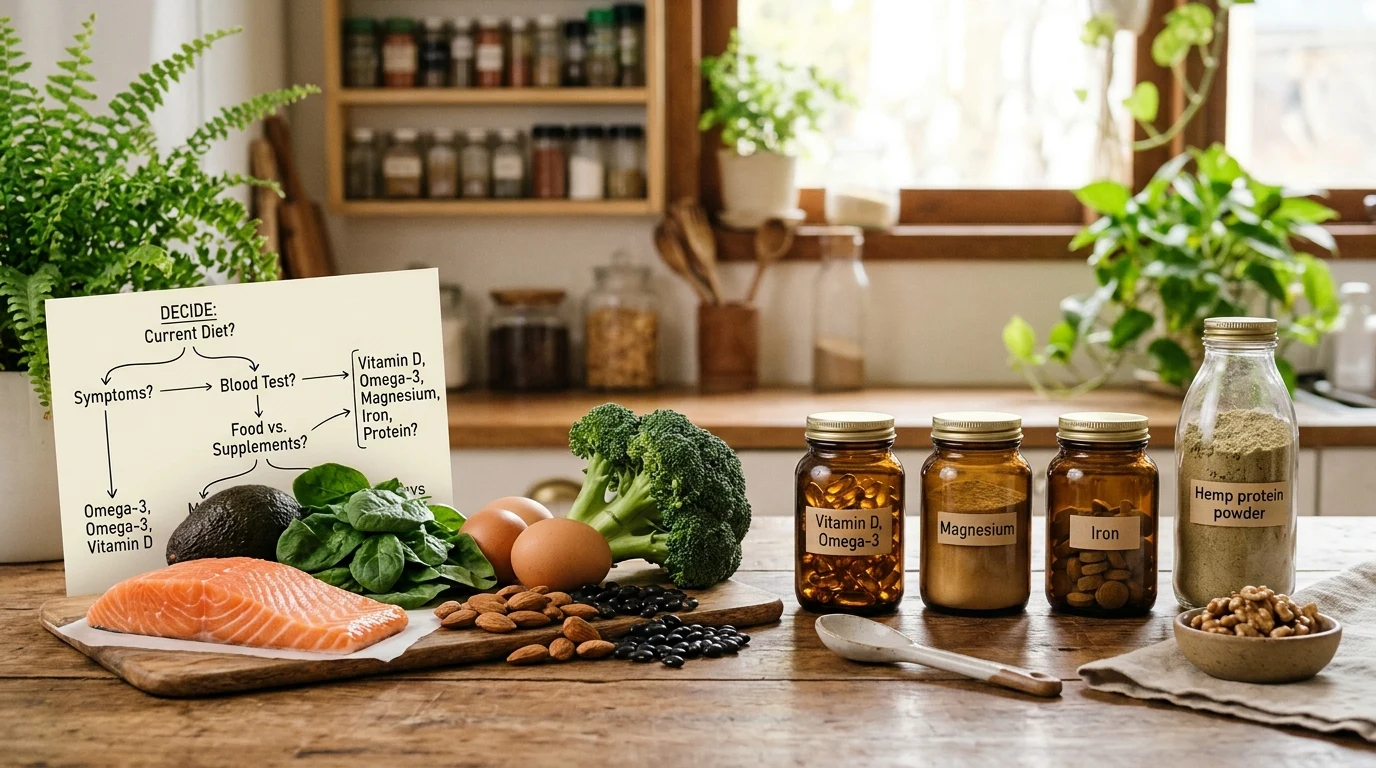
Want to optimise your nutritional foundation without filling cupboards with bottles? Deciding between “improve the diet” and “take a supplement” becomes simpler if you use two criteria: 1) can you realistically reach the target with food (amount and frequency)? and 2) is there a biomarker or clinical sign that justifies speeding up with a supplement? The flowchart below is a practical guide for five key nutrients: vitamin D, omega‑3 (EPA+DHA), magnesium, iron and protein.
How to use this flowchart (3 quick steps)
- Define the target. This can be a biomarker (e.g. 25‑OH vitamin D) or a dietary goal (e.g. 2 portions/week of fatty fish; ~0.8–1.2 g/kg/day protein). For reference: the adult protein intake target is ~0.83 g/kg/day; for older adults many bodies suggest 1.0–1.2 g/kg/day. (https://knowledge-for-policy.ec.europa.eu/health-promotion-knowledge-gateway/dietary-protein-intake-adults-3_en)
- Do the food maths. Use typical per‑portion values (e.g. 3 oz/85 g salmon ≈ 1.8 g EPA+DHA; 1 cup/240 ml fortified milk ≈ 120 IU vitamin D; 1 cup cooked spinach ≈ 157 mg magnesium). If the target requires unrealistic portions for your daily life, supplementation gains weight. (https://ods.od.nih.gov/factsheets/Omega3FattyAcids-HealthProfessional/)
- Check safety and context. There are intake limits (ULs) and clinical situations needing caution (e.g. iron only with blood tests; vitamin D UL 100 µg/day; supplemental magnesium UL 350 mg/day). See safety notes at the end and consult a professional if you have illness or take medication. (https://www.efsa.europa.eu/en/topics/topic/dietary-reference-values)
Vitamin D — food or supplement? (mini‑flowchart)
- Have a 25(OH)D test? If <20 ng/mL (50 nmol/L) most guidelines consider that insufficient for bone health. In this range supplementation is usually more efficient than food/sunlight alone. Talk to your doctor to define dose and re‑testing. (https://ods.od.nih.gov/factsheets/Vitamind-HealthProfessional/)
- No test, but low sun exposure and rarely fortified foods or fish? Diet alone rarely provides enough. In the US, >90% consume <EAR from food only. A daily low‑to‑moderate supplement is often the simplest way to reach ~600–800 IU/day, respecting the adult UL of 4,000 IU (100 µg). (https://ods.od.nih.gov/factsheets/Vitamind-HealthProfessional/)
- Prefer to try food first? Focus on rich/fortified sources: cooked sockeye salmon 3 oz ≈ 570 IU; fortified cow’s or plant milk ≈ 120 IU per cup (check the label). If your weekly sum doesn’t average near 600 IU/day, supplementation remains the pragmatic option. (https://ods.od.nih.gov/factsheets/VitaminD-HealthProfessional/?uid=9e8308e0069c78s16)
Useful notes: universal screening for vitamin D in healthy people is not recommended; lab methods and interpretation vary. (https://ods.od.nih.gov/factsheets/Vitamind-HealthProfessional/)
Omega‑3 (EPA+DHA) — food or supplement? (mini‑flowchart)
- Start here: do you eat fatty fish 1–2 times/week? The American Heart Association recommends at least 2 servings/week; this typically gives an average daily intake of ~250–500 mg/day EPA+DHA if you pick fatty species (salmon, sardines, mackerel). (https://www.heart.org/en/healthy-living/healthy-eating/eat-smart/fats/fish-and-omega-3-fatty-acids)
- Do the maths with real examples. Per 85 g portion: farmed salmon ≈ 1.24 g DHA + 0.59 g EPA; canned sardines ≈ 0.74 g DHA + 0.45 g EPA. Two weekly servings of salmon (~3.7 g EPA+DHA/week) average ~0.53 g/day. If you dislike or avoid fish, a daily supplement can be simpler. (https://ods.od.nih.gov/factsheets/Omega3FattyAcids-HealthProfessional/)
- Vegan/vegetarian? Conversion of ALA (flax, chia, walnuts) to EPA/DHA is limited (<15%). In that case a microalgae‑derived DHA/EPA supplement is a direct alternative. (https://ods.od.nih.gov/factsheets/Omega3FattyAcids-HealthProfessional/)
- Want to be objective? The Omega‑3 Index (EPA+DHA % in red‑cell membranes) is used in research; values >8% are often cited as desirable, though it’s not routine clinical testing. (https://pmc.ncbi.nlm.nih.gov/articles/PMC11809719/)
Safety and high doses: EFSA and FDA consider up to ~5 g/day EPA+DHA generally safe long‑term, but 4 g/day over years slightly increased atrial fibrillation risk in people with cardiovascular risk. Monitor if you use anticoagulants. (https://ods.od.nih.gov/factsheets/Omega3FattyAcids-HealthProfessional/)
Magnesium — food or supplement? (mini‑flowchart)
- Start with food. Practical sources: leafy greens, legumes, nuts, seeds and whole grains. Examples: 1 cup cooked spinach ≈ 157 mg; 28 g almonds ≈ 77 mg. Two to three servings of these across the day bring many people close to the target (European AI ~300–350 mg/day). (https://lpi.oregonstate.edu/sites/lpi.oregonstate.edu/files/2026-02/magnesium.pdf)
- Hard to reach by diet? Not uncommon: population surveys show intakes below the EAR for many people. If your diet is low in vegetables and whole foods, a low–moderate supplement can fill the gap. (https://ods.od.nih.gov/factsheets/magnesium-healthProfessional/)
- Caution on form and dose. The supplemental UL for magnesium (from supplements/medicines) is 350 mg/day for adults, mainly to avoid diarrhoea and GI discomfort. High doses should be clinically assessed. (https://ods.od.nih.gov/factsheets/Magnesium-HealthProfessional/?crsi=4077191147)
Iron — food or supplement? (mini‑flowchart)
- Golden rule: iron only with tests. Request haemogram, ferritin and transferrin saturation (TSAT). Without inflammation many experts use ferritin ≤30 ng/mL as suggestive of deficiency; with inflammation cut‑offs rise (e.g. ferritin <100 ng/mL or TSAT <20%). The CDC classic cut‑off for depleted stores is ≤15 ng/mL — thresholds vary by guideline and clinical context. (https://doi.org/10.1182/bloodadvances.2025015950%20)
- If mild deficiency is confirmed and you prefer to start with diet: combine iron sources with vitamin C (e.g. beans + pepper/orange) and avoid coffee/tea at iron‑rich meals. Heme iron (meat/fish) is better absorbed; non‑heme (plant) absorption depends on meal composition. (https://ods.od.nih.gov/factsheets/Iron-HealthProfessional/)
- Supplement when it makes sense. In confirmed deficiency supplements are more effective short‑term than diet alone. Avoid taking them with calcium/antacids and talk to your doctor about dose/schedule and re‑testing. EFSA set a safe intake level for total iron of 40 mg/day in adults; people with haemochromatosis should not supplement. (https://medlineplus.gov/ency/article/007478.htm)
Protein — food or supplement? (mini‑flowchart)
- Calculate your daily target. Healthy adults: ~0.83 g/kg/day; over 65 many bodies recommend 1.0–1.2 g/kg/day to preserve muscle mass and function. Example: 70 kg → ~58 g/day (young adult) to ~70–84 g/day (older adult). (https://knowledge-for-policy.ec.europa.eu/health-promotion-knowledge-gateway/dietary-protein-intake-adults-3_en)
- Can you reach it with food? Approximate per‑portion examples: 1 egg ≈ 7 g; 100 g cooked lentils ≈ 8–9 g; 100 g cooked chicken breast ≈ 31 g. Many people hit targets by distributing 20–30 g protein per meal. (https://www.bhf.org.uk/informationsupport/heart-matters-magazine/nutrition/protein)
- When is a protein powder helpful? If schedule or appetite make the target hard to reach, a scoop can simplify matters but isn’t mandatory. Pay attention to the product’s nutrition ‘package’ (added sugar/sweeteners/protein quality) and use powders as a complement, not a habitual replacement for whole food. (https://nutritionsource.hsph.harvard.edu/what-should-you-eat/protein/?trk=article-ssr-frontend-pulse_little-text-block)
How to do the maths without overcomplicating (3 examples)
- Omega‑3 without fish: practical target ~250–500 mg/day. One 85 g portion of canned sardines gives ≈1.2 g EPA+DHA. If you don’t eat fish during the week, a daily supplement of 500–1,000 mg EPA+DHA may be more realistic than relying on ALA (conversion <15%). Check interactions if you use anticoagulants. (https://ods.od.nih.gov/factsheets/Omega3FattyAcids-HealthProfessional/)
- Vitamin D in an office‑bound winter: add your weekly sources and you may find only 1 cup/day of fortified plant milk (≈120 IU) and rare fish intake — well below the ~600 IU/day common target. A daily supplement (staying under the 100 µg/4,000 IU UL) is the simplest route, with 25(OH)D testing later to confirm adequacy. (https://ods.od.nih.gov/factsheets/VitaminD-HealthProfessional/?uid=9e8308e0069c78s16)
- Magnesium with a diet low in greens/legumes: target ~300–350 mg/day. A plate with 1 cup cooked spinach (157 mg) + 28 g almonds (77 mg) totals ~234 mg; if the rest of the day doesn’t cover the remainder, a low–moderate supplement can make sense, remembering the supplemental UL of 350 mg. (https://lpi.oregonstate.edu/sites/lpi.oregonstate.edu/files/2026-02/magnesium.pdf)
Safety notes (read before supplementing)
Sources
- Vitamin D - Health Professional Fact Sheet (NIH ODS) — . Definições de suficiência/insuficiência, limitações do rastreio e intervalos de 25(OH)D.
- Omega-3 Fatty Acids - Health Professional Fact Sheet (NIH ODS) — Conteúdos EPA+DHA por porção (tabela); segurança e interações; ALA <15%.
- Fish and Omega-3 Fatty Acids (American Heart Association) — Recomendação de 2 porções/semana de peixe, preferindo peixe gordo.
- Dietary recommendations for protein intake for adults and older adults (EU K4P/EFSA) — PRI de ~0,83 g/kg/dia em adultos; comentário sobre gamas adequadas.
- ESPEN Expert Group — Protein intake and exercise for optimal muscle function with aging (2013) — Recomendação 1,0–1,2 g/kg/dia para >65 anos.
- EFSA — Dietary reference values (inclui ULs e nível seguro de ferro) — UL vitamina D = 100 µg/dia; nível seguro de ingestão de ferro = 40 mg/dia em adultos.
- Magnesium - Health Professional Fact Sheet (NIH ODS) — Fontes alimentares, inadequação populacional e UL (350 mg/dia de suplementos).
- Linus Pauling Institute (OSU) — Magnesium (folha informativa) — Exemplos práticos por porção: espinafres e amêndoas.
- Iron - Health Professional Fact Sheet (NIH ODS) — Heme vs não‑heme, fatores que aumentam/reduzem absorção.
- CDC — Iron‑Status Indicators (2026) — Cut‑offs clássicos de ferritina (≤15 ng/mL) e interpretação de TSAT.
- ASH press release (2026) — New standards for diagnosing iron deficiency — Cortes mais altos (ex.: ferritina <100 ng/mL com inflamação; TSAT <20%).
- Harvard T.H. Chan — The Nutrition Source: Protein — Contexto sobre fontes de proteína e avaliação do “pacote” alimentar.
- British Heart Foundation — Protein: how much do you need? — Valores aproximados por porção: ovo (~7 g), lentilhas cozidas (~8 g/100 g).
- NIH ODS — Vitamin D (alimentos fortificados e conteúdos por porção) — Exemplos: salmão (sockeye) 3 oz ≈ 570 UI; leite/bebidas vegetais ≈ 120 UI/copo.
- Vitamin D - Health Professional Fact Sheet
- Recent studies confirm the utility of the omega-3 index - PMC
- Magnesium - Health Professional Fact Sheet
- American Society of Hematology 2026 guidelines for diagnosis of iron deficiency | Blood Advances | American Society of Hematology
- Taking iron supplements: MedlinePlus Medical Encyclopedia
- Protein • The Nutrition Source
Sources listed by the authors. Always confirm information with a healthcare professional.