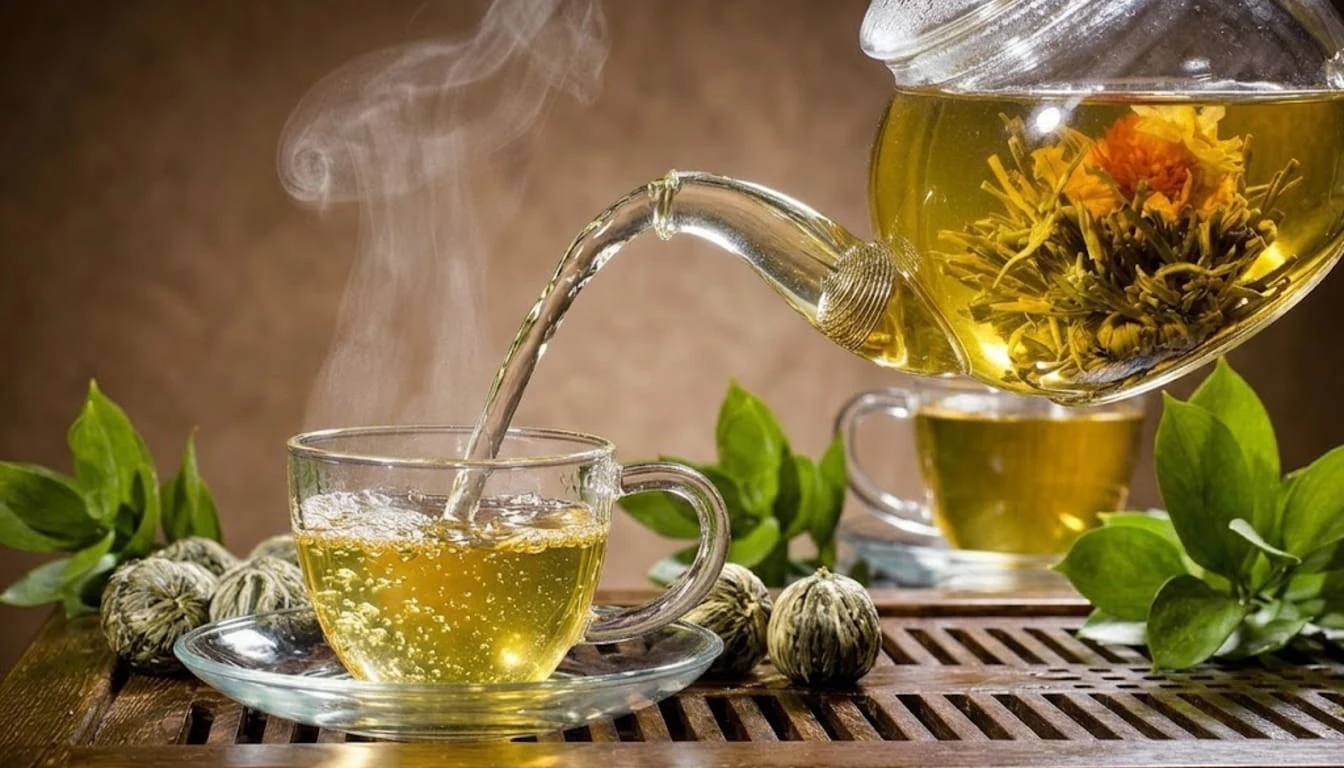
Green tea is one of the oldest and cheapest biohacks. For those seeking calm focus, more stable daytime energy and a low‑friction longevity habit, it’s an excellent starting point. Below I explain why it produces a feeling of “calm energy”, how to use it to reduce crashes, what the evidence says about brain and heart protection, and practical advice on brewing, typical intake and when to consider capsules.
Green tea as a nootropic: calm-focused energy
Green tea combines two complementary molecules: caffeine (stimulates alertness) and L‑theanine (an amino acid linked to relaxation without sedation). Controlled trials show the L‑theanine+caffeine combination can improve attention and speed/accuracy on cognitive tasks, with fewer distractions — a profile often described by users as “calm focus”. These trials used doses (for example 100–250 mg L‑theanine with 40–150 mg caffeine) that are higher than a typical cup, but they help explain why many people feel clearer and less jittery when they switch from coffee to green tea. (https://pubmed.ncbi.nlm.nih.gov/18681988/)
Part of the smoother effect comes from total caffeine dose: a 240 ml cup of green tea generally contains less caffeine than a cup of filtered coffee. Clinical sources report typical values of ~25–50 mg per cup of green tea versus ~80–100 mg for coffee, and advise not exceeding ~400 mg/day of caffeine in healthy adults. For people who get anxious with coffee, that difference is often decisive. (https://www.mayoclinic.org/healthy-lifestyle/nutrition-and-healthy-eating/in-depth/caffeine/art-20049372)
Swap coffee to avoid crashes: a simple 10–14 day trial
If you experience energy peaks and troughs, try this swap for 10–14 days: keep your morning coffee if you need it, and replace the afternoon coffee with green tea. Lower caffeine and the likely modulatory effect of L‑theanine tend to reduce jitteriness and the sharp energy drop several hours later.
- Morning: 1 cup of green tea 20–60 minutes after waking when you want focus without nervousness. If you truly need coffee, keep a morning coffee and switch to green tea for the rest of the day.
- Mid‑afternoon: 1 cup of green tea instead of a second coffee. Many readers report less anxiety and better sleep at night with this change.
- If you’re highly sensitive to caffeine: try decaffeinated green tea in the afternoon — it keeps many polyphenols with much less caffeine.
- Cold brew (4–8 hours in the fridge): usually produces a less bitter flavour, extracts relatively more L‑theanine and less caffeine than hot infusion, which helps avoid peaks. (https://www.sciencedirect.com/science/article/pii/S0308814625010398)
How to brew well (without “ruining” the tea)
The common mistake is using boiling water. Lower temperatures preserve flavour and avoid excessive extraction of tannins (bitterness). For bioactive compounds, most EGCG (the main catechin) and caffeine extract well around 80–90 ºC. Very high temperatures and long infusions favour chemical changes and astringent taste — they don’t destroy everything, but they’re not optimal. (https://www.mdpi.com/2304-8158/14/5/745/pdf?version=1740212731)
Step by step (hot infusion)
- Heat water to 75–85 ºC (small bubbles form; if you don’t have a thermometer, let a boiled kettle rest 2–3 minutes).
- Use 2–3 g of leaf per 200–250 ml of water.
- Infuse 2–3 minutes and taste. If it’s bitter, reduce time or temperature; if it tastes weak, slightly increase time or leaf amount.
Useful variations
- Cold brew (4–8 h in the fridge): extracts less caffeine and highlights L‑theanine — good for caffeine sensitivity. (https://www.sciencedirect.com/science/article/pii/S0308814625010398)
- Matcha (whole‑leaf powder): delivers more caffeine and catechins per serving than typical infusions; start small if you’re sensitive. (https://pmc.ncbi.nlm.nih.gov/articles/PMC10665233/)
- Decaffeinated: retains relevant polyphenols with much reduced caffeine — a safe option for late afternoon/evening. (https://doi.usp.org/USPFCC/FCC_F104407_06_01.html)
“Does it keep the mind young?” What the evidence does — and doesn’t — show
There are two kinds of evidence to consider. First, acute human studies show L‑theanine+caffeine improves attention and performance on demanding tasks — useful for immediate focus but not proof of effects on brain ageing. (https://pubmed.ncbi.nlm.nih.gov/18681988/)
Second, long‑term observational studies in populations who regularly drink green tea associate the habit with lower risk of cognitive decline and dementia. For example, Japanese cohort studies found daily green tea drinkers had lower probability of cognitive decline than non‑drinkers. These are associations, not proof of causality, and lifestyle and overall diet also matter. (https://pmc.ncbi.nlm.nih.gov/articles/PMC4020750/)
Systematic reviews indicate green tea intake can improve some markers of oxidative stress and inflammation (e.g., increased total antioxidant capacity and reduced MDA), although results vary between populations and doses. Practically speaking, consuming 1–4 cups per day aligns with patterns linked to lower risk and has a favourable safety profile. (https://pmc.ncbi.nlm.nih.gov/articles/PMC8614888/)
Heart and longevity: where the evidence is stronger
The most consistent associations are in cardiovascular outcomes. Meta‑analyses of prospective studies suggest drinking tea (green and/or black) is linked to lower risk of cardiovascular events and mortality, with modest reductions per additional cup and a probable plateau after a few cups. These data don’t replace foundational habits (sleep, diet, exercise), but support tea as a sensible daily choice. (https://pmc.ncbi.nlm.nih.gov/articles/PMC7360449/)
How many cups per day? When to stop
For most adults, 2–4 cups/day is a practical range that balances potential benefit and caffeine tolerance. Large cohorts reported associations between ~1.5–4 cups/day and lower all‑cause and cardiovascular mortality, with diminishing returns above that. (https://pmc.ncbi.nlm.nih.gov/articles/PMC11573487/)
Respect your personal caffeine limit (general maximum ~400 mg/day; adjust if you’re more sensitive). If you have insomnia, move the last cup earlier or use decaffeinated green tea in the evening. (https://www.fda.gov/consumers/consumer-updates/spilling-beans-how-much-caffeine-too-much)
Infusions vs capsules: when they make sense and safety tips
If the goal is daily focus and long‑term benefit, prefer the beverage. Traditional infusions are considered safe, while concentrated green tea extracts (high in EGCG) raise liver safety concerns at high doses. European authorities concluded that ≥800 mg/day of EGCG from supplements can increase liver enzymes, especially when taken on an empty stomach as a single concentrated dose. (https://onlinelibrary.wiley.com/doi/pdfdirect/10.2903/j.efsa.2018.5239)
- If you still choose capsules/extracts: pick products that clearly state EGCG per dose; avoid taking them fasting; and avoid concentrated EGCG doses without clinical supervision — several safety reviews link high doses of green‑tea extracts to liver risk in some users. The prudent approach is to follow manufacturer recommendations and consult a healthcare professional before using supplements with high EGCG content. (https://pubmed.ncbi.nlm.nih.gov/29580974/?uid=21c85128485458s16)
- In healthy adults, the brewed beverage typically provides 50–100 mg of catechins per 250 ml cup (varies widely). It’s a slower, more diluted way to get these compounds than capsules. (https://ods.od.nih.gov/factsheets/ImmuneFunction-HealthProfessional/)
- If you experience gastric discomfort, nausea or pain in the upper right abdomen after starting extracts, stop and consult your physician. (https://www.nccih.nih.gov/health/green-tea?uid=8a6c3ce7ed039s16)
Safety and interactions: what to keep in mind
Sources and notes include caffeine limits in pregnancy; beverage safety; hepatic risk with extracts; interactions with warfarin; and interference with non‑heme iron absorption. (https://www.fda.gov/consumers/consumer-updates/spilling-beans-how-much-caffeine-too-much)
A simple routine to start tomorrow
- Choose a good green (sencha, longjing/dragon well, gyokuro or a transparent‑label bagged option).
- Morning: 1 cup at 75–85 ºC for 2–3 minutes. Observe focus and mood in the first hour.
- Mid‑afternoon: swap the second coffee for 1 cup of green tea (or decaf, if you’re sensitive).
- If your stomach is sensitive, pair the cup with a light snack; avoid taking concentrated EXTRACTS on an empty stomach.
- Want even less caffeine? Cold brew in the fridge and carry it with you. (https://www.sciencedirect.com/science/article/pii/S0308814625010398)
Sources
- EFSA assesses safety of green tea catechins (press release, 18 Abr 2018) — /segurança de catequinas; infusões seguras; 800 mg EGCG em suplementos pode elevar transaminases
- Scientific opinion on the safety of green tea catechins (EFSA Journal, 2018) — opinião científica completa; dados sobre jejum/toma em bolus e enzimas hepáticas
- Caffeine content for coffee, tea, soda and more — Mayo Clinic — conteúdos típicos de cafeína por chávena
- Spilling the Beans: How Much Caffeine is Too Much? — FDA — limite geral de ~400 mg/dia; exemplos por bebida
- The combined effects of L-theanine and caffeine on cognitive performance and mood (RCT) — melhorias de atenção e desempenho com L‑teanina+cafeína
- L-theanine and caffeine in combination affect human cognition and alpha activity — evidência eletrofisiológica e desempenho atencional
- The effects of L-theanine, caffeine and their combination on cognition and mood (RCT) — efeitos combinados vs isolados
- The Association between Green Tea Consumption and Cognitive Function: A Meta-Analysis — associações entre consumo e menor risco de défice cognitivo
- Consumption of Green Tea… and Reduced Risk of Cognitive Decline (Nakajima Project) — coorte japonesa; menor declínio cognitivo com consumo diário
- Dose–Response Relation between Tea Consumption and Risk of CVD and All‑Cause Mortality (meta‑análise) — associação entre maior consumo de chá e menor risco cardiovascular/mortalidade
- Tea consumption and risk of all‑cause, CVD, and cancer mortality (38 coortes) — reduções modestas de risco; indicação de platô com poucas chávenas
- Green tea — NCCIH (NIH) — segurança geral da bebida e aviso de interações com suplementos/medicação
- ODS (NIH) — Immune Function Fact Sheet (dados de catequinas por chávena) — ~50–100 mg de catequinas/250 ml; contexto de chá como fonte de catequinas
- From fresh tea to the tea infusion: brewing temperature and catechin stability (2026) — 80–90 ºC como faixa prática para evitar degradação excessiva e extrair catequinas
- Cold‑brewed green tea: menor cafeína, mais L‑teanina (metabolómica) — redução >40% de cafeína vs quente; ligeiro aumento de L‑teanina
- Green Tea: Current Knowledge and Issues
- Catechin Composition, Phenolic Content, and Antioxidant Properties of Commercially-Available Bagged, Gunpowder, and Matcha Green Teas - PMC
- Tea Polyphenols from Green Tea, Decaffeinated
- The safety of green tea and green tea extract consumption in adults - Results of a systematic review - PubMed
- Effect of brewing conditions on catechins (Saklar et al., 2015) — maior extração de EGCG por volta de 80–85 ºC; efeito do tempo/temperatura
- Effect of Green Tea Supplementation on Antioxidant Status in Adults (meta‑análise de RCTs) — marcadores de stress oxidativo; resultados heterogéneos
- ACOG — Quanto café posso beber na gravidez? — limite de ~200 mg/dia de cafeína na gravidez
- Probable antagonism of warfarin by green tea (case report) — redução do INR associada a consumo elevado de chá verde; relevância prática para varfarina
- UCSD Health — Warfarin: Food and Supplement Interactions (inclui chá verde) — orientação clínica; grandes quantidades de chá verde podem reduzir INR
Sources listed by the authors. Always confirm information with a healthcare professional.