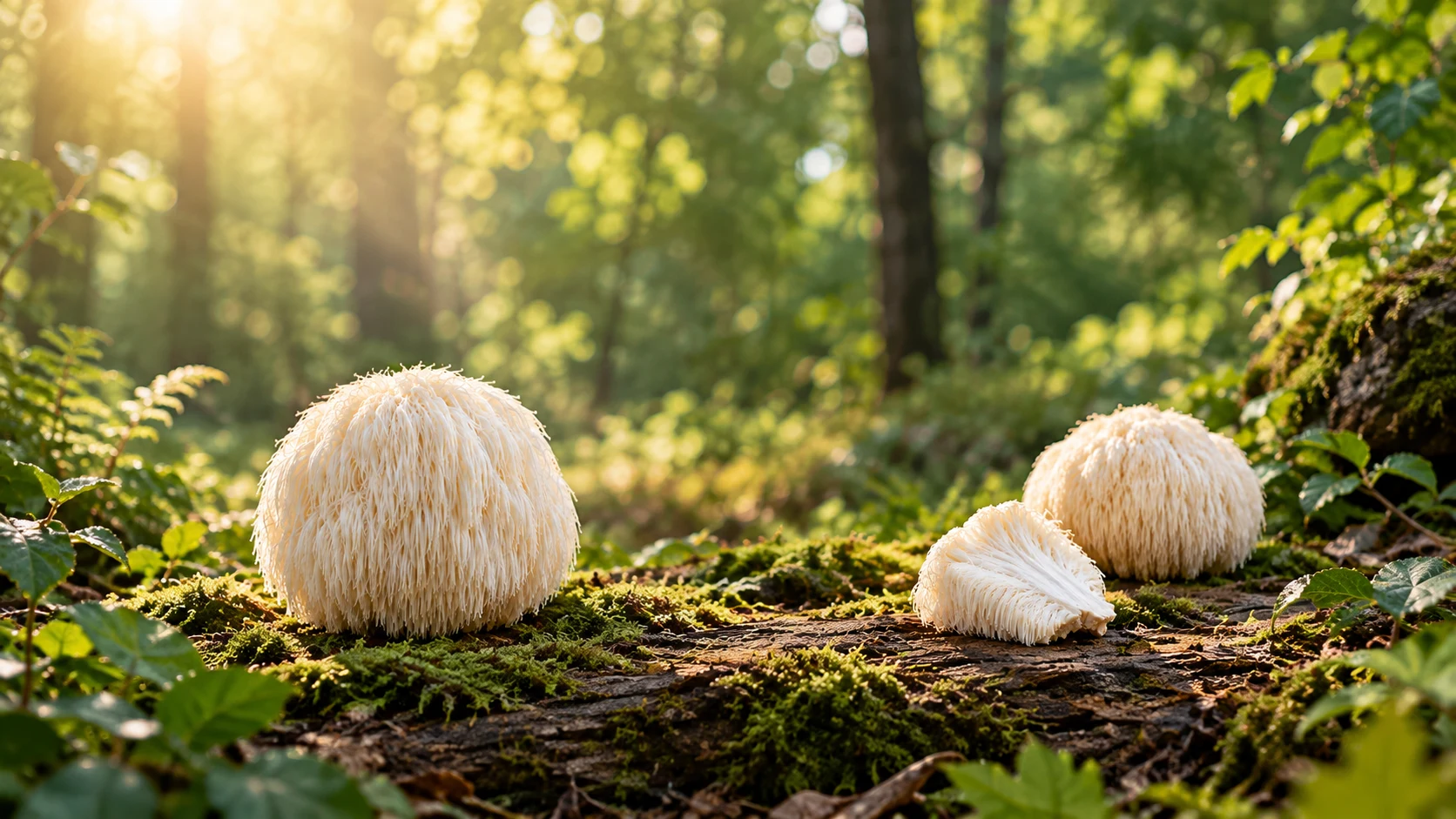
The Lion’s Mane mushroom (Hericium erinaceus) is one of the most discussed natural nootropics. There are human trials — small but respectable — suggesting modest gains in memory and mood, particularly in older adults or people with mild cognitive complaints. It’s not a fast stimulant; benefits tend to require weeks of consistent use and a quality product. Below is the practical guide I would follow to decide, choose dose/form, and test Lion’s Mane over 8 weeks using the available evidence.
What it is and what it can realistically do
Lion’s Mane contains compounds such as hericenones (found mainly in the fruiting body) and erinacines (found in the mycelium). In lab and animal studies these compounds appear to stimulate neurotrophic factors (e.g., NGF/BDNF), lower neural inflammation and offer neuroprotection. Human trials are small but tend to report modest cognitive improvements after 4–16 weeks, and some reductions in anxiety/depression symptoms in specific samples. (pmc.ncbi.nlm.nih.gov)
Practical translation: if you want sustained memory and focus support without caffeine, Lion’s Mane can be a useful foundational supplement — not for immediate spikes but as a slow support. For anxiety, there are encouraging early signals, but evidence remains preliminary and does not replace clinical care when needed. (pmc.ncbi.nlm.nih.gov)
How it may work (simple explanation)
- Boosts neurotrophic factors (NGF/BDNF) in cells and animals, which may support synapses and memory circuits over weeks to months.
- Shows anti‑inflammatory effects on microglia and may influence the gut–brain axis via polysaccharides (β‑glucans).
- Hericenones concentrate in the fruiting body; erinacines are found in the mycelium. Some studies suggest erinacine A crosses the blood–brain barrier in animals.
This explains why immediate results are uncommon: neuroplasticity is slow. Hence, positive trials usually run 4–16 weeks. (pmc.ncbi.nlm.nih.gov)
Human studies — an honest summary
| Population | Design / Duration | Product and dose | Main result | Notes |
|---|---|---|---|---|
| Adults 50–80 with mild cognitive impairment (MCI) | Double‑blind RCT, 16 weeks + 4 weeks follow‑up | Dried fruiting body (≈3 g/day) in tablets | Significant improvement on cognitive scale vs placebo; effect lost 4 weeks after stopping | Well tolerated; mild GI effects similar to placebo |
| Adults with mild Alzheimer’s | Double‑blind RCT, 49 weeks | Mycelium enriched in **erinacine A** (3×350 mg/day; ≈1.05 g/day) | Modest improvements in scores (CASI, MMSE, IADL) and some markers; acceptable safety | Pilot; 4 dropouts due to GI discomfort/skin rash |
| Healthy adults >50 | Double‑blind RCT, 12 weeks | Fruiting body supplement (3–3.2 g/day reported in some accounts) | Signs of improvement on some tests; mixed results across measures | Small sample; needs replication |
| Middle‑aged women with nonspecific complaints | Double‑blind RCT, 4 weeks | Cookies with 2 g/day of fruiting body powder | Reductions in depression/anxiety scores vs placebo | Small study; specific population |
| Healthy younger adults | Pilot trials (acute and 28 days) | Extracts 1.8–3 g/day | Acute results inconsistent; some subtle task gains after 28 days | Evidence is recent and exploratory |
Key references: Mori 2009 (MCI); Li 2020 (erinacine A in early Alzheimer’s); a 2019 Japanese trial in healthy adults; Nagano 2010 (mood); more recent pilots in younger adults (2023–2025). Overall, evidence points to small‑to‑moderate memory benefits in older or clinically vulnerable groups and less consistent effects in young healthy people. (mushroomcouncil.com)
Does it work for focus, memory and anxiety? Short answer
- Memory: “Yes, but slowly” — the clearest findings show up at 8–16 weeks in MCI and possibly in adults >50; stopping usually brings the gain back down.
- Focus/attention in healthy people: mixed results; any benefit may be indirect (via improved sleep/mood) and requires medium‑term use.
- Anxiety/mood: one small RCT in women reported symptom reductions at 4 weeks; this is preliminary and not a substitute for therapy or medication when needed.
If you’re young and healthy, expect subtle effects that depend on product quality and dose. If you have midlife ‘brain fog’, the cost–benefit can be more attractive — but set realistic expectations. (mushroomcouncil.com)
Practical dosing: how to start and timing
Doses used in studies (starting points)
- Fruiting body powder/tablets: 3 g/day for 16 weeks in MCI. (mushroomcouncil.com)
- Mycelium enriched in erinacine A: 3 capsules × 350 mg/day (≈1.05 g/day) for 49 weeks in Alzheimer’s trial. (frontiersin.org)
- Healthy adults: 1.8–3 g/day (28 days to 12 weeks) — mixed results. (mdpi.com)
Practical starting doses (healthy reader)
- Standardized fruiting body extract (β‑glucan reported): 500–1,000 mg, 1–2×/day (roughly equal to ~1–2 g raw material), take with food if you have a sensitive stomach.
- Unstandardized powder (fruiting body): 1–3 g/day, split into two doses.
- Mycelium enriched in erinacine A: only meaningful if the label/COA states erinacine content; study doses were ≈1 g/day. (frontiersin.org)
When to take and how long until you might notice something
- Taking with meals tends to reduce GI discomfort; splitting the dose can improve tolerability. (mushroomcouncil.com)
- Be patient: aim for 4–8 weeks for first signs (memory/mood); acute effects are unlikely.
- Plan an 8‑week cycle before deciding to continue or adjust.
How to choose a quality product (avoid traps)
- Prefer labels that state % β‑glucans (for example ≥20–30% in fruiting‑body extracts) — this is more informative than “total polysaccharides”, which can include substrate starch.
- Ask for a COA that uses a validated method (e.g., Megazyme/AOAC for β‑glucans) and shows tests for heavy metals/microbiology.
- Know the difference: fruiting body (richer in hericenones) vs mycelium (contains potential erinacines). Mycelium grown on grain can be high in starch and low in active β‑glucans — read the label.
- The Alzheimer study used mycelium enriched in erinacine A (pharmaceutical grade), which is rare in retail products. Don’t assume any mycelium powder equals that formulation.
Why insist on β‑glucans? AOAC/ASTM methods can distinguish β‑glucans from α‑glucans (starch). Several analyses show that reporting “polysaccharides” alone does not guarantee potency. There have even been petitions to the FDA seeking clearer labeling between “mushroom” and “mycelium‑on‑grain.” (academic.oup.com)
8‑week test plan — how I would run a personal trial
Editorial note: there are no guaranteed effects. The goal of this self‑test is to maximise the chance of noticing meaningful change while avoiding wasted time and money.
Week 0 — Preparation (2–3 days)
- Choose a product with β‑glucans declared and a COA; pick a form — a fruiting‑body extract is my recommended start.
- Define simple metrics: 1) a word‑list memory test you repeat weekly, 2) a 5‑minute attention task (e.g., mental countdown), 3) brief daily mood/anxiety scales (0–10).
- Set a routine: 500 mg 2×/day with breakfast and lunch; keep caffeine habits stable.
Weeks 1–2 — Tolerance and baseline
- Take 500 mg 2×/day; if you get GI issues, lower to 500 mg/day for 3–4 days.
- Log sleep, energy, mood, focus (0–10) and any GI symptoms.
- If tolerated with no problems, continue.
Weeks 3–4 — First checkpoint
- Repeat your memory and attention tests under the same conditions.
- If you still notice nothing, consider increasing to 750–1,000 mg 2×/day (only if the product is a standardized extract).
- If GI irritation appears, revert to the previous dose or always take with food.
Weeks 5–8 — Consolidation
- Keep the effective dose steady; avoid changing many variables (sleep, caffeine).
- For mood/anxiety aims, continue daily logs; when present, effects usually show between 4–8 weeks.
- At the end of Week 8 compare averages to baseline (Week 0). Decide to continue, take a 2–4 week break to test reversibility, or stop.
Signs to adjust or stop
- Persistent GI discomfort, skin rashes, or a clear worsening of focus/fogginess — reduce dose or stop.
- If after 8 weeks there’s no objective or subjective change, consider a different nootropic or first improving sleep/exercise/creatine.
- If you’re on medication or have neurological/autoimmune conditions, consult your healthcare professional before continuing.
Smart stacking (optional)
- Pair with caffeine + L‑theanine for immediate focus while Lion’s Mane works in the background.
- Combine with creatine (3–5 g/day) given evidence for cognitive support via cellular energy.
- Avoid adding multiple new adaptogens at once — it becomes hard to know what’s producing an effect.
Evidence for specific synergies is limited; these are pragmatic choices to cover the lack of acute effects. Use your logs to decide whether to keep stacking. (pmc.ncbi.nlm.nih.gov)
Safety and warnings
My personal experience: what I actually felt
As I've been using supplements for a while, I decided to run a controlled experiment with Lion's Mane. The rule was simple: without changing absolutely anything in my daily supplement stack, diet, or routine, I introduced Lion's Mane to isolate the variable and see if the impact I felt was truly from it.
What I noticed (Cognition and Memory)
The results in the cognitive area were very positive and aligned with the idea that this is a "slow-burn" supplement. I noticed a clear improvement in day-to-day information retention. More than that, I felt my reasoning became clearer and more structured. The most interesting point was the improvement in long-term memory — something the scientific literature suggests can take weeks to manifest through neuroplasticity, and which I ended up validating in practice.
What I didn't notice (Anxiety and Mood)
I know Lion's Mane also promises (and has preliminary studies pointing to) a reduction in anxiety and depression symptoms. In my case, I didn't feel any impact in this area. The reason is purely pragmatic: I already take other supplements that significantly reduced my anxiety. Since my mental and anxious "noise" was already controlled by the base stack I was taking, it was impossible to evaluate whether Lion's Mane would have any additional effect on my mood.
Worth it? If you want a slow nootropic to support memory and wellbeing over weeks — and you commit to buying a quality product and running an 8‑week test — Lion’s Mane is a reasonable bet. For immediate focus you’ll still need complementary strategies (sleep, caffeine/teanine, stress management). The smartest choice is to measure, adjust and only keep it if it objectively adds value to you.
Sources
- Improving effects of the mushroom Yamabushitake (Hericium erinaceus) on mild cognitive impairment: a double-blind placebo-controlled clinical trial (Phytotherapy Research, 2009) — PDF — Ensaios em MCI; 3 g/dia; ganhos perderam-se após parar.
- Prevention of Early Alzheimer’s Disease by Erinacine A-Enriched Hericium erinaceus Mycelia — Pilot Double-Blind Placebo-Controlled Study (Frontiers in Aging Neuroscience, 2020) — PDF — Micélio enriquecido em erinacina A; 1,05 g/dia por 49 semanas.
- Improvement of cognitive functions by oral intake of Hericium erinaceus (Biomedical Research, 2019) — artigo e PDF — Estudo randomizado em adultos saudáveis; corpo de frutificação; 12 semanas.
- Therapeutic Potential of Hericium erinaceus for Depressive Disorder (MDPI/PMC, 2020) — Revê Nagano 2010: 2 g/dia em biscoitos; sintomas depressão/ansiedade.
- Hericium erinaceus in Neurodegenerative Diseases: From Bench to Bedside (PMC, 2023) — Mecanismos (NGF/BDNF; erinacinas passam BHE em animais).
- Lion’s Mane Mushroom: Narrative Review (PMC, 2024) — Hericenonas/erinacinas; efeitos anti-inflamatórios; teores estimados.
- Systematic review — Benefits, side effects, and uses of Hericium erinaceus (Frontiers in Nutrition, 2025) — PDF — Síntese de estudos clínicos; limitações metodológicas.
- Acute effects of a standardised extract of Hericium erinaceus on cognition and mood in healthy younger adults (Frontiers in Nutrition, 2025) — PDF — Efeitos agudos inconsistentes em jovens saudáveis.
- The Acute and Chronic Effects of Lion’s Mane Mushroom Supplementation on Cognitive Function, Stress and Mood in Young Adults: A Double-Blind, Parallel Groups, Pilot Study — 1,8 g/dia em jovens; resultados mistos; piloto.
- AOAC Journal — Advances in Enzymatic Measurement of β‑Glucan (2026) — Métodos validados para quantificar β‑glucanos (qualidade do produto).
- FDA Docket — Petition on “mushroom” vs “mycelium on grain” labeling (2023) — PDF — Contexto de rotulagem; confusão entre corpo frutificação e micélio em cereal.
- Benefits, side effects, and uses of Hericium erinaceus as a supplement: a systematic review - PMC
Sources listed by the authors. Always confirm information with a healthcare professional.