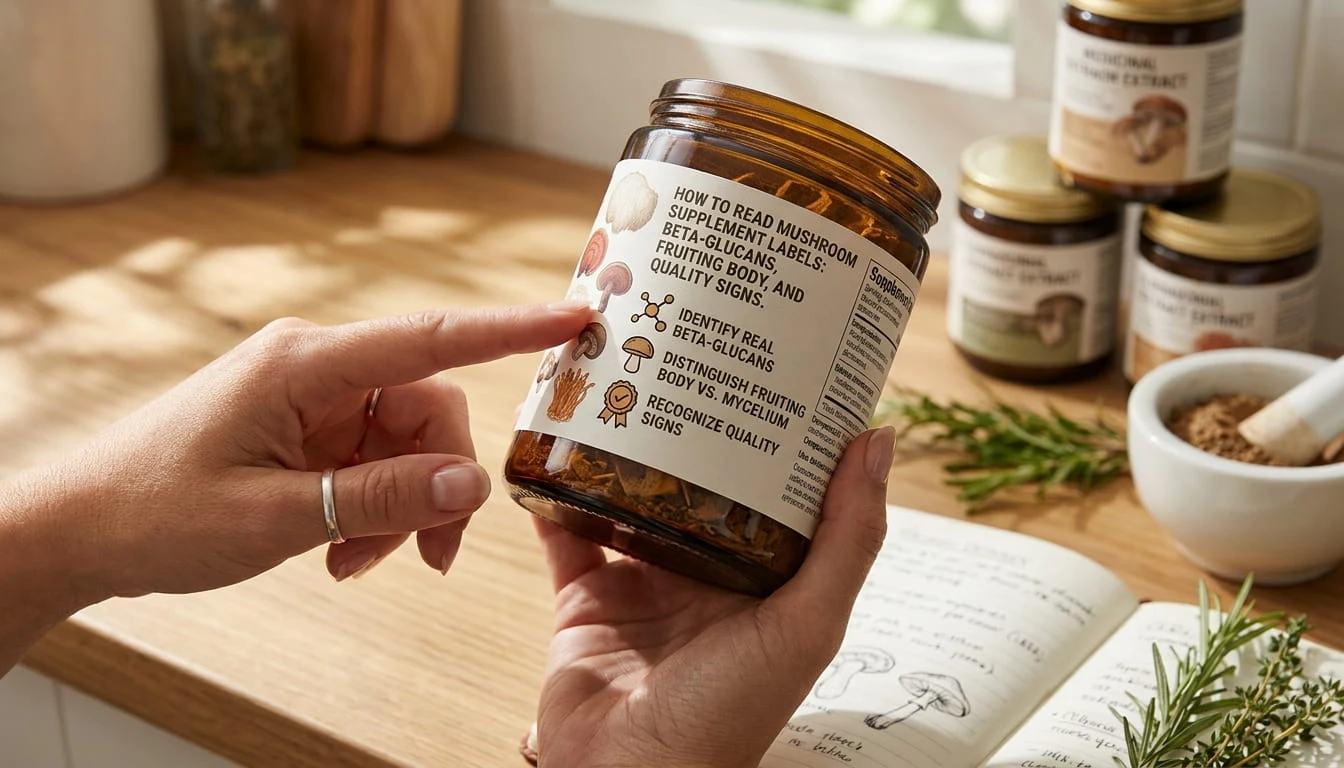
Buying a mushroom supplement seems straightforward until you read the label: “polysaccharides 30%”, “mycelium biomass”, “extract 10:1”, “fruiting body”. Those terms can mean very different things in practice. This guide helps you interpret labels and ask the right questions — focusing on Lion’s Mane, Reishi and Cordyceps — so you can pick products with measured beta‑glucans, declared fungal part and transparent extraction methods.
First principle: polysaccharides are not the same as beta‑glucans
Beta‑glucans are among the most studied mushroom components and are important for immune‑related effects. They are measured with specific enzymatic methods such as K‑YBGL (Megazyme/Neogen), described in the Journal of AOAC International, which quantifies beta‑glucans after subtracting α‑glucans (starch/glycogen). In practice, the correct label item is “beta‑glucans (%)” with the method referenced, not only “polysaccharides (%).” (megazyme.attachments3.freshdesk.com)
Why does this matter? “Polysaccharides” is a broad group that can include starch (α‑glucan) and other carbohydrates coming from the cultivation substrate, especially when the product is mycelium grown on grains. Actual mushrooms contain no starch; their cell walls are mainly chitin and beta‑glucans, with small amounts of other sugars. So a label saying “polysaccharides 40%” may sound good but tells little about true beta‑glucans. (wiseathletes.com)
There is a technical detail: some assays may detect components from grain (including cereal β‑glucans) if the sample contains mycelial biomass with substrate residues. In comparative studies of Chaga supplements, the presence of starch was a useful marker of grain‑derived material and authors note analytical limitations when cereals are present. Bottom line: insist on beta‑glucan numbers measured by an explicit method, not just “polysaccharides”. (pmc.ncbi.nlm.nih.gov)
Fruiting body vs mycelium: what really changes (and when it matters)
“Fruiting body” (the visible mushroom) and “mycelium” (the filamentous network) are different parts of the same organism with distinct chemical profiles. For Lion’s Mane, for example, hericenones are mainly found in the fruiting body while erinacines are characteristic of the mycelium — both groups have been studied for neurotrophic potential. (mdpi.com)
Lion’s Mane (Hericium erinaceus)
If your goal is beta‑glucans and fruiting‑body compounds, choose labels that state “fruiting body” and show beta‑glucan percentage with the method used. If you want mycelial compounds (erinacines), confirm the product truly contains mycelium and ask how it was grown (liquid culture vs grain) and whether erinacines are quantified. Recent literature shows erinacine pathway expression is much higher in mycelium than in the fruiting body, but composition varies with substrate and culture conditions. (pmc.ncbi.nlm.nih.gov)
Reishi (Ganoderma lucidum)
Reishi is rich in two main groups: beta‑glucans (more water‑soluble) and ganoderic triterpenes (more alcohol‑soluble). Water extracts tend to concentrate polysaccharides; alcohol extracts concentrate triterpenes. Quality products often specify hot water extraction (for polysaccharides) and/or alcoholic or dual extraction (for triterpenes), and reference “ganoderic acids/triterpenes”. (pmc.ncbi.nlm.nih.gov)
Cordyceps (C. militaris vs Ophiocordyceps sinensis)
With Cordyceps, species and part used are critical. The marker compound cordycepin is abundant in C. militaris (especially in fruiting bodies) but absent or low/variable in O. sinensis. Many “sinensis” supplements on the market are in practice mycelium‑based. Prefer “Cordyceps militaris fruiting body” and, if possible, quantification of cordycepin (mg/g). (pmc.ncbi.nlm.nih.gov)
What to look for on the label (and the website) — 8 objective points
- Correct scientific name (e.g., Hericium erinaceus, Ganoderma lucidum, Cordyceps militaris).
- Part of the fungus used: fruiting body, mycelium, spores. Industry guidance in the U.S. (AHPA) recommends declaring the part(s); “mushroom” without qualification should mean the fruiting body. (ahpa.org)
- Form and extraction: “powder” (raw ground material) vs extract. For Reishi, look for terms like “hot water extract” (polysaccharides) and/or “ethanol/dual extract” (triterpenes). (pmc.ncbi.nlm.nih.gov)
- Quantified markers and method: beta‑glucans (%) with method (e.g., K‑YBGL/Journal of AOAC Int.). Avoid relying on “polysaccharides (%)” without a method. (megazyme.attachments3.freshdesk.com)
- Other ingredients: claims such as “myceliated brown rice/biomass” indicate grain presence in the final product. (pmc.ncbi.nlm.nih.gov)
- Batch COA (Certificate of Analysis): ideally includes identity (species/part), potency (beta‑glucans; triterpenes/cordycepin when relevant) and contaminants (heavy metals, microbes, pesticides). Programs like USP Verified check label accuracy and contaminant limits. (dev.usp.org)
- Actual dose per serving: how much extract per capsule/measure, not only a ratio (e.g., 10:1). The ratio does not replace % beta‑glucans or other chemical markers.
- Basic legal compliance: U.S. supplement labelling rules require clear declaration of ingredients and plant/fungal part; check for a complete “Supplement Facts” panel and an “Other ingredients” list. (fda.gov)
Marketing red flags
- Only states “polysaccharides (%)” without specifying beta‑glucans or the method. (pmc.ncbi.nlm.nih.gov)
- Says “made with mushrooms” but the ingredient panel lists mycelium/biomass (or omits the part). FDA distinguishes “mycelium” from “mushroom” and AHPA recommends naming the part(s). (fda.gov)
- No batch COA is available or the manufacturer refuses to state the method used for beta‑glucans.
- Only displays an extract ratio (e.g., 10:1) as “proof” of potency, without chemical markers.
- Makes direct clinical claims (treating diseases) — supplements cannot make treatment claims; be suspicious. (fda.gov)
Checklist of questions to ask the manufacturer
- Which part of the fungus is used in this product (fruiting body, mycelium, spores)? In what proportion? (ask for label/COA confirmation). (ahpa.org)
- How do you measure beta‑glucans? Can you share the method (e.g., K‑YBGL, Journal of AOAC Int.) and the result by batch (% on dry weight)? (megazyme.attachments3.freshdesk.com)
- If it is mycelium: was it grown in submerged liquid culture or on grains? Does the COA show starch/α‑glucans? (to exclude excessive grain residue). (pmc.ncbi.nlm.nih.gov)
- What extraction method is used? Hot water for polysaccharides? Ethanol/dual for triterpenes in Reishi? Do you report triterpene/cordycepin numbers when relevant? (pmc.ncbi.nlm.nih.gov)
- Can you provide the full COA (identity, potency, heavy metals, microbes, pesticides, solvents where applicable) for the current batch? Do you have independent certifications (e.g., USP Verified)? (dev.usp.org)
- Are the label values referring to raw material, final extract, or finished capsule?
Practical examples by species (what to prioritise)
Lion’s Mane for focus/clarity
- Look for “fruiting body” + beta‑glucans (%) with a declared method. If you’re interested in erinacines (mycelium), confirm cultivation details and request quantification/COA — erinacines are typical of mycelium and are substrate‑sensitive. (onlinelibrary.wiley.com)
Reishi for stress support/light sleep aid
- Choose extracts with declared method. For beta‑glucans: water extraction. For triterpenes (classic Reishi markers): alcoholic/dual extraction and, ideally, a reported triterpene/“ganoderic acids” content. (pmc.ncbi.nlm.nih.gov)
Cordyceps for energy/training
- Prefer Cordyceps militaris fruiting body and (ideally) cordycepin (mg/g). Beware of labels saying “C. sinensis” that are in practice mycelium; cordycepin may be absent or very low in O. sinensis. (umb.herbalgram.org)
How to translate marketing claims into technical checks
| On the label | What it may mean | How to verify |
|---|---|---|
| “Polysaccharides 30%” | May include starch/α‑glucans; does not quantify beta‑glucans | Request % **beta‑glucans** by K‑YBGL/J. AOAC Int. and, if mycelium, ask for α‑glucans/starch data in the COA. |
| “Mushroom extract” | Extract of part(s) of the fungus — which one(s)? | Require identification: “fruiting body/mycelium/spores”. AHPA recommends declaring the part(s). |
| “Mycelium/biomass” | Mycelium; often contains grain residue | Look for “myceliated rice/oats” in “Other ingredients”; ask for α‑glucans/starch levels. |
| “Dual extract” (Reishi) | Water + alcohol to capture polysaccharides and triterpenes | Check for **beta‑glucans** and, where possible, **triterpenes/ganoderic acids**. |
| “Cordyceps sinensis” | Often mycelium culture; cordycepin may be low/absent | Prefer “C. militaris fruiting body” and request **cordycepin (mg/g)**. |
Is grain‑grown mycelium worth it?
It depends on your goal and the transparency provided. Mycelium has its own chemistry (e.g., erinacines in Lion’s Mane), but when it is grown on grains a portion of what you buy can actually be the grain — and metrics like “polysaccharides (%)” may reflect that. Conversely, some manufacturers argue for the nutritional value of mycelium and point out that beta‑glucans are not the only relevant compounds. The common sensible demand is clear labelling of the part used and the measurement/extraction method. (pmc.ncbi.nlm.nih.gov)
If you choose mycelium, prioritise: (1) a COA that separates beta‑glucans and α‑glucans; (2) disclosure of the substrate and, if possible, mycelium from liquid culture (less grain residue); (3) extraction details and/or species‑specific markers (e.g., erinacines, cordycepin). (megazyme.attachments3.freshdesk.com)
Mini decision guide in 3 steps
- Define your objective by species: Lion’s Mane (clarity/learning), Reishi (relaxation/stress support), Cordyceps (energy/training).
- Choose the part and extraction that match that objective: fruiting body + measured beta‑glucans; when relevant, alcoholic/dual extract for Reishi (triterpenes) or species markers (cordycepin in C. militaris; erinacines in Lion’s Mane mycelium). (pmc.ncbi.nlm.nih.gov)
- Validate quality: batch COA with beta‑glucans (%) and method; identified fungus part(s); “Other ingredients” free from unwanted grains; contaminant tests and GMP compliance. (megazyme.attachments3.freshdesk.com)
Sources
- Megazyme Beta‑Glucan Assay Kit (Yeast & Mushroom) – descrição do método
- Comparative Study of Chaga (Inonotus obliquus) Dietary Supplements Using Complementary Analytical Techniques — Discussão sobre amido como marcador de material de grão e notas sobre limites de métodos
- Kalac P. A review of chemical composition and nutritional value of mushrooms — Revisão: cogumelos com glicogénio/quitina e sem amido/celulose
- Dietary Supplement Labeling Guide – FDA (cap. IV e II) — Obrigatoriedade de declarar a parte de planta/fungo e outros requisitos de rotulagem
- CPG Sec 585.525: Mushroom Mycelium – Fitness for Food; Labeling (FDA) — FDA distingue “mycelium” de “mushroom” para rotulagem clara
- AHPA Guidance Policies – rotulagem de ingredientes fúngicos — Recomenda identificar a(s) parte(s): fruiting body/mycelium/spores
- Lion’s Mane: Narrative Review (Nutrients 2024) — hericenonas (corpo frutífero) e erinacinas (micélio)
- Neurohealth Properties of Hericium erinaceus Mycelia Enriched with Erinacines (2018, open access) — Resumo: erinacinas do micélio
- Influences of substrate and tissue type on erinacine production (2025, open access) — Expressão superior de genes de erinacinas no micélio; variação por substrato
- From Remedy to Therapy: confronting bioavailability bottlenecks in Reishi (2026) — Água para polissacarídeos; etanol para triterpenos
- Cordyceps militaris—Fruiting Bodies, Mycelium, and Supplements (Foods 2022) — Dados comparativos; cordicepina em C. militaris
- BAPP Botanical Adulterants Prevention Program — Cordyceps Adulteration Bulletin (2024) — Sinensis com cordicepina ausente/baixa vs militaris rica em cordicepina
- USP Verification Services — o que é verificado — Verificação de rótulo e limites de contaminantes
- Small Entity Compliance Guide — 21 CFR Part 111 (GMP) — Boas Práticas de Fabrico para suplementos (EUA)
- Measurement of β-Glucan in Mushrooms and Mycelial Products
- Questions and Answers on Dietary Supplements | FDA
Sources listed by the authors. Always confirm information with a healthcare professional.