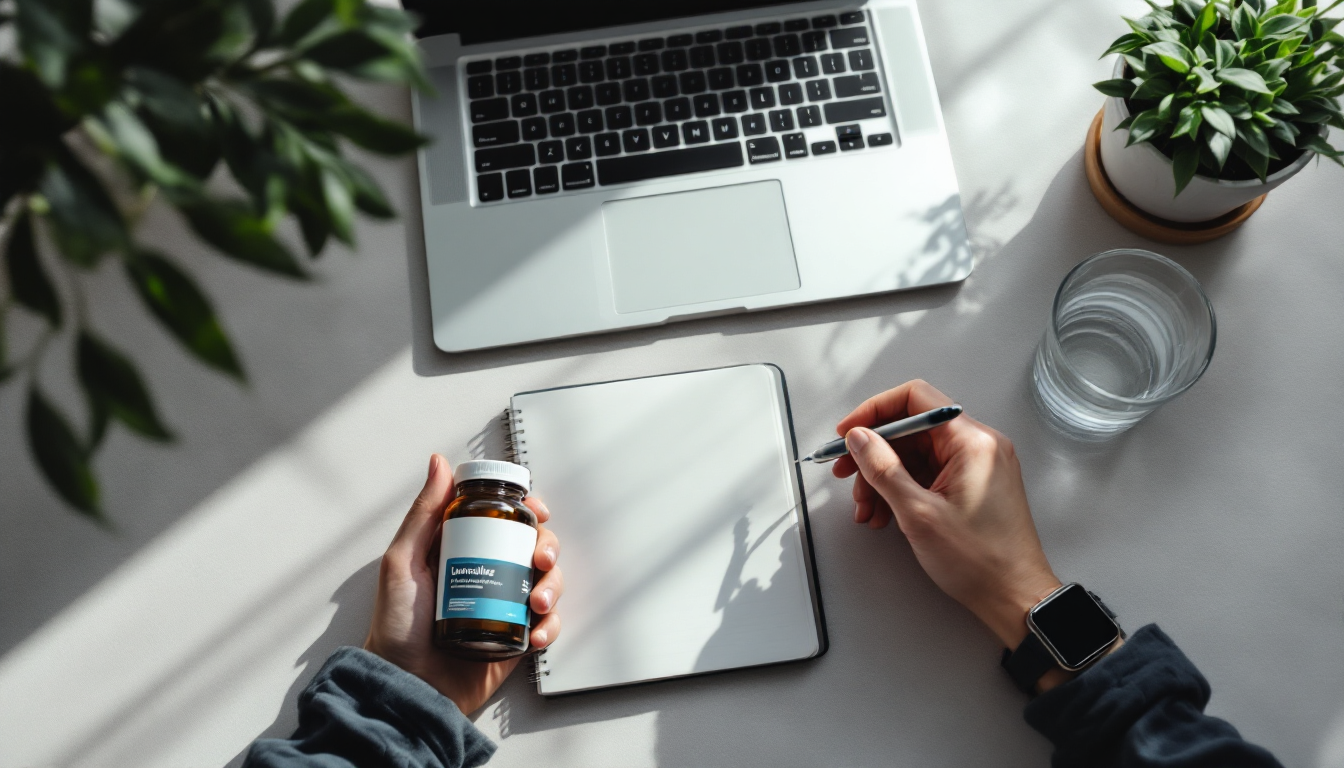
Focus and creativity are different mental states. For a 4–6 hour work block, what you take before and during the session can bias your brain toward sustained attention (productivity) or freer association (creativity). Below are two concise, practical mini‑protocols — micro‑doses, timing, signs to adjust and cheaper alternatives — designed for people who want clear results without complexity. In my routine I use caffeine + L‑theanine as the baseline; I test modules only on selected days.
How to choose: Productivity vs Creativity
In short, productivity seeks steady vigilance, reduced distraction and faster responses. Creativity needs calm alertness, less dopamine/adrenergic “grip” and more cognitive flexibility (avoid tunnel vision). The classic pairing caffeine + L‑theanine improves aspects of attention and reaction time in several acute trials, but effects are dose‑ and context‑dependent. (pmc.ncbi.nlm.nih.gov)
- If you need to execute (coding, focused writing, intense study): pick the Productivity Protocol.
- If you need to ideate (brainstorming, design, strategy): pick the Creativity Protocol.
- If you're sleep deprived or jet‑lagged: use the indicated variants (moderate caffeine, L‑theanine and circadian support). (pmc.ncbi.nlm.nih.gov)
Protocol A — Productivity (4–6 hours of sustained focus)
Objective and rationale
Goal: create a plateau of steady alertness without sharp peaks, and preserve working memory. The base is caffeine + L‑theanine; L‑tyrosine is optional when stress or sleep loss is present; citicoline can help low‑grade mental‑effort headaches in some people.
Base stack (beginners) — T‑45 minutes
- Caffeine 50–100 mg (light coffee/tea or tablet). Stay below your personal threshold; EFSA considers up to 200 mg per dose and 400 mg/day generally safe for healthy adults. (efsa.europa.eu)
- L‑theanine 100–200 mg (capsule). Smooths caffeine effects and can favor selective attention in some contexts. (pmc.ncbi.nlm.nih.gov)
Optional intermediates — T‑45 minutes
- L‑tyrosine 300–600 mg. Helpful under acute stress or sleep loss to support performance; evidence is stronger in demanding situations. Avoid with MAOIs and evaluate if you take levodopa. (pubmed.ncbi.nlm.nih.gov)
- Citicoline (CDP‑choline) 150–250 mg. Small trials suggest subtle attention benefits after weeks; use as an aid if you get mental‑effort headaches. (scirp.org)
Boosters during the session (T+120–180 minutes)
- If focus drops: caffeine 25–50 mg + L‑theanine 50–100 mg.
- Avoid big one‑off caffeine hits; keep total daily caffeine <400 mg (healthy adults). (efsa.europa.eu)
Signals to adjust
- Tremor/anxiety: lower the next caffeine dose and increase L‑theanine (example: 50 mg caffeine + 200 mg theanine). (pmc.ncbi.nlm.nih.gov)
- Mental‑effort headache: consider 150–250 mg citicoline or a break + hydration. (scirp.org)
- Severe mental fatigue under pressure: try L‑tyrosine 300–600 mg pre‑task on critical days. (pubmed.ncbi.nlm.nih.gov)
Protocol B — Creativity (4–6 hours of divergent thinking)
Objective and rationale
Goal: an alert calm state — reduce internal noise and anxiety while keeping associative range. We avoid strong dopaminergic/adrenergic spikes that produce tunnel thinking.
Base stack (beginners) — T‑30 to T‑45 minutes
- Caffeine 25–50 mg (or green tea). A low dose to avoid compressing thought. EFSA indicates 200 mg per dose is generally safe; here we stay well below that. (efsa.europa.eu)
- L‑theanine 150–200 mg. Helps reduce unhelpful mind wandering and stabilise attention without narrowing. (sciencedirect.com)
Optional modules — T‑45 minutes
- Panax ginseng 100–200 mg (standardized extract). Some acute trials report modest cognitive task benefits; systematic reviews are inconclusive. Use only if you know you tolerate it. (pmc.ncbi.nlm.nih.gov)
- Ginkgo biloba 60–120 mg (EGb 761). Acute effects are inconsistent; it may raise bleeding risk with anticoagulants. (pubmed.ncbi.nlm.nih.gov)
- High‑risk optional: nicotine 0.5–1 mg (e.g., 1/4–1/2 of a 2 mg lozenge using a chew‑and‑park method). Not recommended for non‑smokers due to addiction risk. (stacks.cdc.gov)
Signals to adjust
- If you feel slow: raise caffeine to 50–75 mg while keeping L‑theanine ≥150 mg. (pmc.ncbi.nlm.nih.gov)
- If thinking becomes too linear: drop ginseng/ginkgo and stick to theanine + low caffeine.
- If you tried nicotine: log post‑session craving or irritability — signs to stop. (stacks.cdc.gov)
Quick micro‑dose checklist for a 4–6 hour session
| Time | Productivity | Creativity |
|---|---|---|
| T‑45 min | Caffeine 50–100 mg + L‑theanine 100–200 mg | Caffeine 25–50 mg + L‑theanine 150–200 mg |
| T‑45 min (optional) | L‑tyrosine 300–600 mg; Citicoline 150–250 mg | Panax ginseng 100–200 mg OR Ginkgo 60–120 mg (optional; mixed evidence) |
| T+120–180 min | Caffeine 25–50 mg + L‑theanine 50–100 mg | Caffeine 25 mg OR nothing; keep theanine 50–100 mg if needed |
| End | Water + light protein; 5–10 min sunlight | Short walk + light stretching |
Variants: beginners, intermediates and jet lag
Beginners (first 2–3 sessions)
- Stick to caffeine + L‑theanine only; log the response and that night’s sleep.
- Start low (e.g., 50 mg caffeine) and increase only after you evaluate. EFSA: ≤200 mg per dose and ≤400 mg/day are generally safe for healthy adults. (efsa.europa.eu)
Intermediates (after you know your tolerance)
- Productivity: add L‑tyrosine only on high‑demand or sleep‑deprived days.
- Creativity: trial ginseng on non‑deadline days — evidence is inconsistent. (cochrane.org)
Travelers (jet lag) — 4–6 h morning session
- Keep caffeine low‑to‑moderate and use L‑theanine to reduce peaks in a sleep‑deprived brain. (pmc.ncbi.nlm.nih.gov)
- For nights: melatonin 0.3–1 mg 2–3 hours before desired sleep time for short‑term jet‑lag management. Reviews support melatonin to reduce jet lag. (cochrane.org)
Budget and minimalist alternatives
- Coffee + L‑theanine (caps) is the best price/value baseline.
- L‑tyrosine is inexpensive; reserve for high‑stress days.
- If you skip citicoline for cost reasons, prioritise breaks, hydration and choline‑rich foods (eggs) — citicoline trials in healthy people show small effects, often after weeks and with some industry sponsorship. (pmc.ncbi.nlm.nih.gov)
Safety, interactions and when NOT to use
Comparative table — what to take, when and why
| Category | Compounds | Typical adult dose | When to use | Evidence note |
|---|---|---|---|---|
| Productivity base | Caffeine + L‑theanine | 50–100 mg + 100–200 mg | T‑45 min; booster 25–50 mg + 50–100 mg mid‑session | Acute trials show modest improvements in attention/reaction time in some contexts. ([pmc.ncbi.nlm.nih.gov](https://pmc.ncbi.nlm.nih.gov/articles/PMC8794723/)) |
| Productivity module | L‑tyrosine | 300–600 mg | T‑45 min on stress/sleep‑loss days | Meta‑analyses/reviews indicate benefit under high demand. ([pubmed.ncbi.nlm.nih.gov](https://pubmed.ncbi.nlm.nih.gov/26424423/)) |
| Productivity support | Citicoline (CDP‑choline) | 150–250 mg | Pre‑session or daily for 4–12 weeks | Small RCTs (some industry‑sponsored) suggest subtle attention/memory improvements. ([scirp.org](https://www.scirp.org/html/8-2700397_19921.htm)) |
| Creativity base | Caffeine + L‑theanine (low dose) | 25–50 mg + 150–200 mg | T‑30/45 min | Balances alertness and calm; avoids tunnel vision. ([sciencedirect.com](https://www.sciencedirect.com/science/article/pii/S0271531717304967)) |
| Creativity module (optional) | Panax ginseng | 100–200 mg | T‑45 min | Acute evidence mixed; Cochrane review finds no convincing global effect. ([pmc.ncbi.nlm.nih.gov](https://pmc.ncbi.nlm.nih.gov/articles/PMC2952762/)) |
| Creativity module (optional) | Ginkgo biloba (EGb 761) | 60–120 mg | T‑45 min | Inconsistent acute outcomes; watch for bleeding interactions. ([pubmed.ncbi.nlm.nih.gov](https://pubmed.ncbi.nlm.nih.gov/17902186/?dopt=Abstract&utm_source=openai)) |
| Jet lag (sleep aid) | Melatonin | 0.3–1 mg | 2–3 h before bedtime, short term | Reviews support effectiveness for reducing jet lag. ([cochrane.org](https://www.cochrane.org/evidence/CD001520_melatonin-prevention-and-treatment-jet-lag)) |
How to test it in 7 days (without overcomplicating)
- Days 1–2: only caffeine + L‑theanine at a low dose. Track focus, anxiety and that night’s sleep.
- Days 3–4: pick a protocol (Productivity or Creativity) and repeat the doses you felt best with.
- Days 5–6: add one module (L‑tyrosine OR ginseng/ginkgo) if needed.
- Day 7: repeat the session that felt best; confirm whether effects are consistent.
- Simple metrics: 1) tasks completed/quality, 2) sense of control (0–10), 3) time to fall asleep that night.
Sources
- The Cognitive-Enhancing Outcomes of Caffeine and L-theanine: A Systematic Review - PMC
- Caffeine | EFSA
- Effect of tyrosine supplementation on clinical and healthy populations under stress or cognitive demands--A review - PubMed
- Improved Attentional Performance Following Citicoline Administration in Healthy Adult Women
- l-Theanine and caffeine improve target-specific attention to visual stimuli by decreasing mind wandering: a human functional magnetic resonance imaging study - ScienceDirect
- Effects of American ginseng (Panax quinquefolius) on neurocognitive function: an acute, randomised, double-blind, placebo-controlled, crossover study - PMC
- Modulation of cognitive performance following single doses of 120 mg Ginkgo biloba extract administered to healthy young volunteers - PubMed
- The Health Consequences of Smoking: Nicotine Addiction: A Report of the Surgeon General
- No convincing evidence of a cognitive enhancing effect of Panax ginseng. | Cochrane
- Melatonin for the prevention and treatment of jet lag | Cochrane
- Citicoline and Memory Function in Healthy Older Adults: A Randomized, Double-Blind, Placebo-Controlled Clinical Trial - PMC
- Ginkgo: Usefulness and Safety | NCCIH
- Herb-Drug Interactions: What the Science Says | NCCIH
- Rhodiola | Memorial Sloan Kettering Cancer Center
Sources listed by the authors. Always confirm information with a healthcare professional.