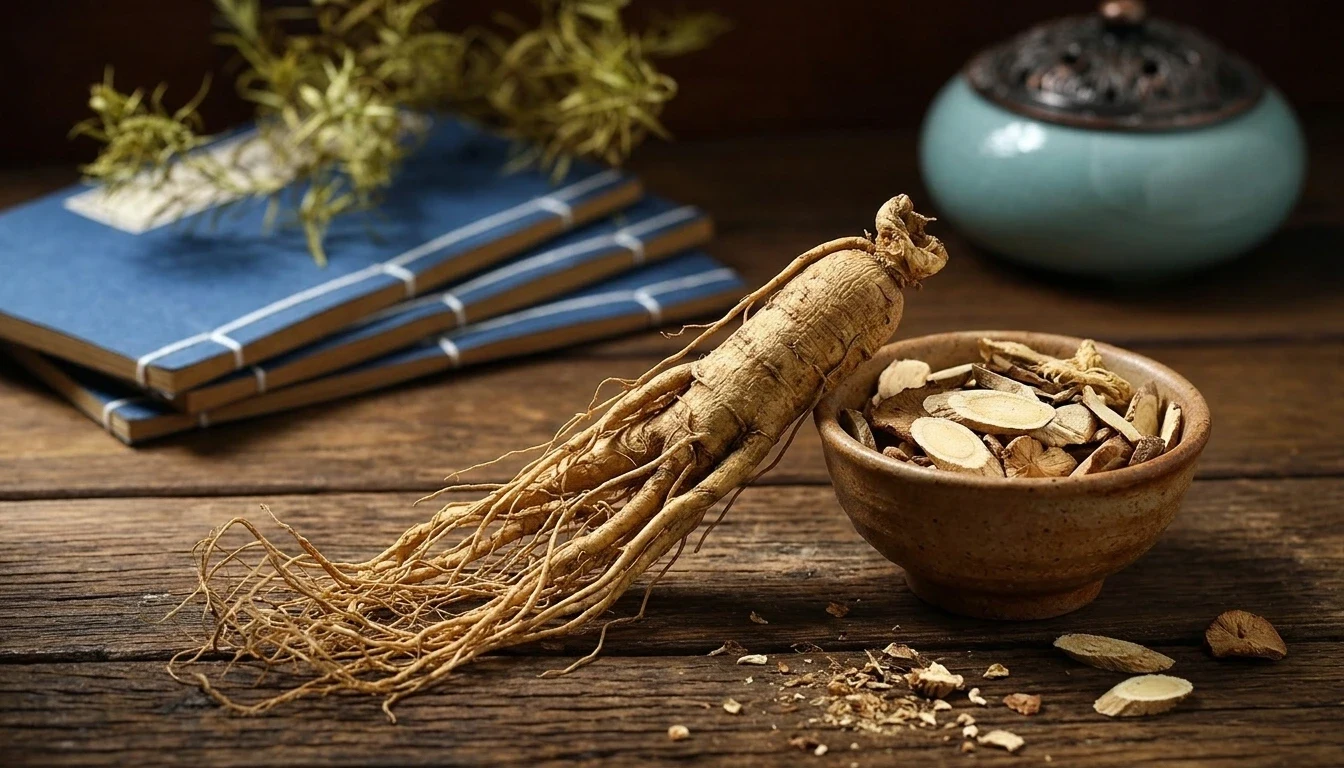
Panax ginseng (often called the “root of life”) has been used for centuries to recover from tiredness and boost vitality. What does the current evidence actually show, and how can you use it in daily life without disrupting sleep while choosing a supplement worth taking?
What Panax ginseng is and what it does in practice
“Ginseng” in the strict sense refers to plants of the Panax genus. The most studied species is Panax ginseng (Asian ginseng, often labelled Korean or Chinese). “Siberian ginseng” (Eleutherococcus senticosus) is not true ginseng and does not contain ginsenosides, the characteristic compounds of Panax. This distinction matters when you read a label: if it lists Eleutherococcus, it isn’t Panax. (https://www.accessdata.fda.gov/cms_ia/importalert_143.html)
In Europe, Panax ginseng is recognised as a traditional herbal medicinal product for relieving symptoms of asthenia such as fatigue and weakness. That means there is long experience of use and an established safety profile for this purpose, but efficacy is not robustly proven by high‑quality clinical trials for all popular uses. (https://www.fitoterapia.net/archivos/202407/final-european-union-herbal-monograph-panax-ginseng-camey-radix-revision-1_en.pdf)
What do studies show? For cognition (memory, attention), the more conservative systematic reviews have not found convincing, consistent benefits in healthy people. For disease‑related fatigue, a 2022 meta‑analysis of 12 randomized trials reported a small to moderate reduction in fatigue with ginseng. In short: it may help some people feel less fatigued, but don’t expect a coffee‑like boost in concentration. (https://www.cochrane.org/evidence/CD007769_no-convincing-evidence-cognitive-enhancing-effect-panax-ginseng)
Is it an energy boost like coffee? What to realistically expect
Ginseng is not a stimulant like caffeine. When it helps, the effect is usually subtle: a bit more energy and motivation and less sense of exhaustion. At the same time, insomnia is a reported adverse effect, especially with higher doses or in sensitive individuals. The practical rule is to take it in the morning and avoid late‑day use. (https://www.nccih.nih.gov/health/asian-ginseng)
- Typical effect when it works: mild improvement in well‑being and fatigue tolerance without marked stimulation.
- What NOT to expect: a rapid alertness spike like with coffee or energy drinks.
- If you feel jittery or notice palpitations, reduce the dose or stop and reassess. Seek clinical advice if symptoms are significant.
To reduce gastrointestinal discomfort, you can take ginseng with food. If there is no irritation, taking it with or without food is usually fine — follow the product label. (https://my.clevelandclinic.org/health/drugs/19105-ginseng-capsules-or-tablets)
When to take it, how long and what doses you’ll see on labels
Time of day
Morning or early afternoon. Avoid taking it near bedtime to reduce the risk of sleep disturbance. (https://myhealth.alberta.ca/Health/medications/Pages/conditions.aspx?hwid=fdb8311)
Duration (‘breaks’)
European monographs indicate continuous use up to 3 months, with re‑evaluation if symptoms persist. A practical approach is to use it in blocks (for example, one 3‑month block during periods of higher demand), then pause and decide whether to resume. (https://www.fitoterapia.net/archivos/202407/final-european-union-herbal-monograph-panax-ginseng-camey-radix-revision-1_en.pdf)
Common doses (and why they vary)
Doses depend on the preparation. Standardised extracts usually show a percentage of ginsenosides (eg, 4–7%). In practice, two credible references you’ll encounter are:
- EMA/European monograph: for a dry root extract with 4% ginsenosides (DER 3–7:1), typical daily doses in technical documents range from 40 to 200 mg (in some technical contexts up to 600 mg for initial days). For other preparations in the same monograph the range can be ~200–700 mg/day. (https://www.fitoterapia.net/archivos/202407/final-european-union-herbal-monograph-panax-ginseng-camey-radix-revision-1_en.pdf)
- Canadian monograph / supplement labelling: 200–600 mg/day of a standardised extract at 4–7% ginsenosides; for root powder, 1–2 g/day. (https://webprod.hc-sc.gc.ca/nhpid-bdipsn/atReq?atid=ginseng.panax2)
For red ginseng (root steamed before drying), many studies use 1–3 g/day of root powder or equivalent extracts for 4–12 weeks. (https://pmc.ncbi.nlm.nih.gov/articles/PMC6190493/)
How to choose a good supplement (without needing a chemistry degree)
1) Check the botanical name and part used
Look for “Panax ginseng C.A. Meyer, root”. Avoid labels that only say “ginseng” without specification, and remember: “Siberian ginseng” (Eleutherococcus) is not Panax. (https://www.accessdata.fda.gov/cms_ia/importalert_143.html)
2) Look for clear standardisation
An “standardised extract” with a stated % ginsenosides (eg, 4–7%) helps ensure consistency between batches. Classic extracts such as G115 declare 4% ginsenosides and a plant:extract ratio (DER) of 3–7:1. (https://pmc.ncbi.nlm.nih.gov/articles/PMC7031746/)
3) Check ginsenoside amount per dose
If a label lists 200 mg of extract at 5% ginsenosides, that equals 10 mg ginsenosides per capsule. This calculation helps compare products.
4) Choose white or red root according to your goal
Root can be sold as white ginseng (air‑dried) or red ginseng (steamed then dried). Processing changes the ginsenoside profile: red ginseng tends to contain some different ginsenosides and, on average, a higher total content. It’s not automatically better, just different — follow what works for you. (https://pmc.ncbi.nlm.nih.gov/articles/PMC7582514/)
5) Prefer independent quality seals
Seals such as USP Verified or NSF Certified for Sport indicate third‑party testing for composition and contaminants. They don’t guarantee efficacy, but they reduce the risk of adulteration and inaccurate labels. Variability between non‑standardised products has been documented. (https://www.usp.org/sites/default/files/usp/document/products-services/dietary-supplement-verification-summary-final.pdf)
6) Avoid proprietary blends and hidden stimulants
Prefer simple labels with a clear Panax ginseng dose and no mixes with stimulants. Watch out for “energy” formulas that contain caffeine without prominent labelling.
Safety: who should be cautious and practical advice
These precautions are based on official monographs and expert safety sources. Reported adverse effects are usually mild gastrointestinal complaints and insomnia. Use particular caution with drugs affecting coagulation and with glucose‑lowering therapies. (https://www.fitoterapia.net/archivos/202407/final-european-union-herbal-monograph-panax-ginseng-camey-radix-revision-1_en.pdf)
Quick checklist to integrate ginseng into your routine
- Define the goal: reduce general fatigue? support long study/work sessions?
- Choose a standardised root extract with a clear label (4–7% ginsenosides) and, if possible, a USP or NSF seal.
- Take in the morning and follow the label dose; if sensitive, start at half for 3–5 days.
- Monitor sleep in the first days. If insomnia appears, move the dose earlier or reduce it.
- Use blocks up to 3 months and re‑evaluate. For continuous use, consult a healthcare professional.
- If on chronic medication (especially anticoagulants/antidiabetics), check for interactions before starting. (https://www.fitoterapia.net/archivos/202407/final-european-union-herbal-monograph-panax-ginseng-camey-radix-revision-1_en.pdf)
Panax ginseng can be a modest, well‑tolerated option to reduce feelings of fatigue for some people, but it is not a fast stimulant and evidence for cognitive enhancement in healthy adults is weak. Use morning dosing, prefer standardised extracts, watch for sleep effects and check drug interactions when relevant. If fatigue persists or is severe, seek medical evaluation.
Sources
- European Union herbal monograph on Panax ginseng C.A.Mey., radix (Revision 1, 29 May 2024) — /Posologia, duração máxima (3 meses), reações adversas e precauções/
- Asian Ginseng — Usefulness and Safety (NCCIH) — /Perfil de segurança; insónia como efeito mais comum/
- Ginseng for cognition (Cochrane Review) — No convincing evidence of cognitive enhancing effect of Panax ginseng — /Síntese da evidência em cognição/
- Efficacy of ginseng supplements on disease‑related fatigue: A systematic review and meta‑analysis (2022) — /Redução da fadiga relacionada com doença/
- Dietary Supplements for Immune Function — Consumer fact sheet (ODS/NIH) — /Efeitos secundários e interações gerais (incl. insónia em doses altas)/
- Warfarin Sodium Tablets — FDA label (DailyMed): botanical interactions list includes Panax ginseng — /Sinal de possível interação com anticoagulantes/
- Import Alert 54‑12 (FDA): Only Panax species may be represented as “ginseng”; Eleutherococcus cannot be labeled as ginseng — /Distinção legal entre Panax e Eleutherococcus/
- Variability in commercial ginseng products: an analysis of 25 preparations (AJCN) — /Variabilidade de ginsenosídeos e importância da padronização/
- NSF Certified for Sport — what the certification means — /Certificação independente para qualidade e contaminantes/
- USP Dietary Supplement Verification Program — Overview — /Selo USP Verified e o que avalia/
- Diversity of ginsenoside profiles produced by various processing technologies — /Diferenças entre ginseng branco e vermelho (perfil de ginsenosídeos)/
- Red ginseng monograph/review — doses correntes e diferenças vs white ginseng — /Contexto de doses em estudos e processamento/
- Ginseng: Uses, Interactions & Side Effects
- Ginseng (Eleutherococcus And Panax Sp.) - Oral
- The G115 standardized ginseng extract: an example for safety, efficacy, and quality of an herbal medicine - PMC
Sources listed by the authors. Always confirm information with a healthcare professional.