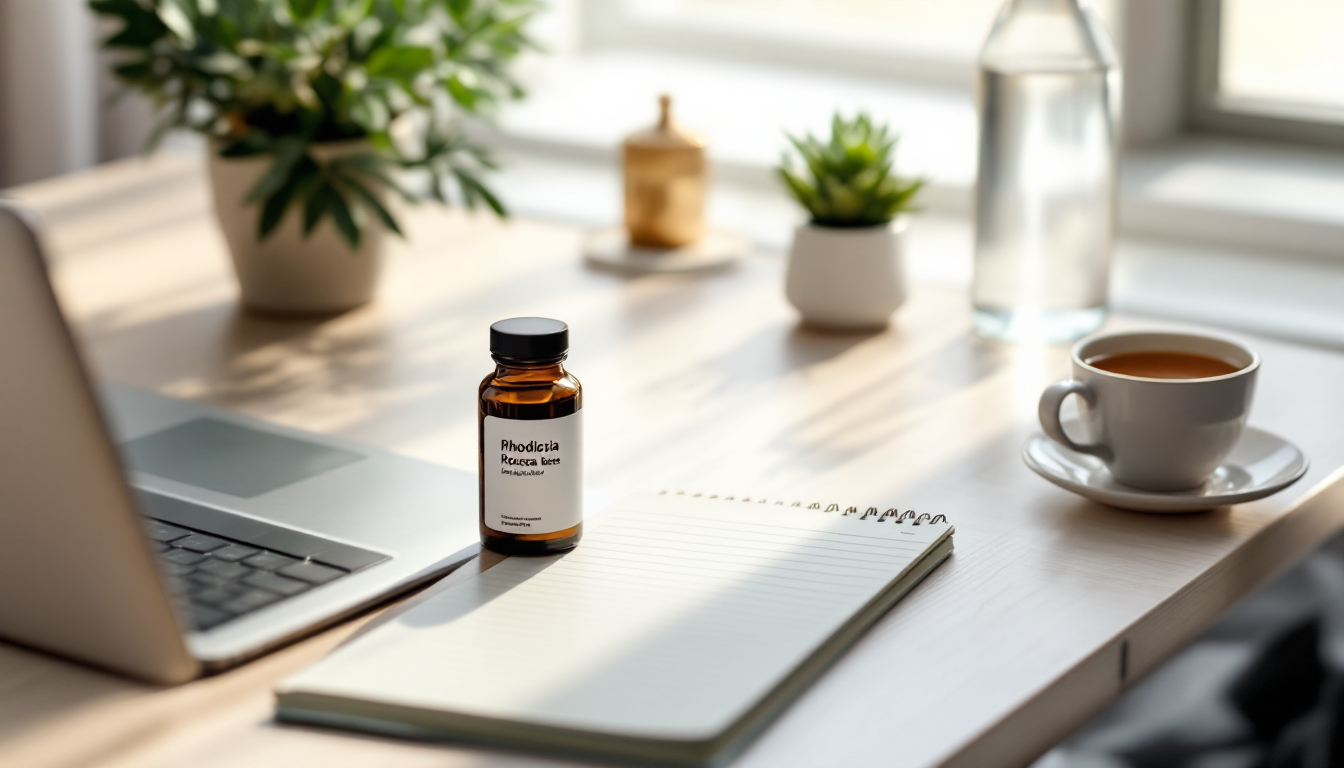
Looking for steadier energy and sharper focus without the jitters and crash of caffeine? Rhodiola rosea is a classic adaptogen used to reduce fatigue and improve mental performance under stress. Human evidence is moderate (small but consistent trials) and points to benefits mainly in situations of high mental load or sleep loss. Unlike direct stimulants, Rhodiola tends to smooth the stress response rather than produce fast peaks; still, it’s not a magic bullet — extract quality and dose matter.
Quick take: does it work? Who benefits and when
- For energy and focus under pressure: controlled trials with the SHR‑5 extract showed improved attention and reduced fatigue in people with stress‑related fatigue and in doctors working night shifts. Benefits are moderate, clearer when sleep is reduced or cognitive load is high. (pubmed.ncbi.nlm.nih.gov)
- For training and sport: evidence is mixed, but reviews and trials report small gains (time to exhaustion, repeated sprints); effects seem likelier in intermittent effort or decision‑making under fatigue. (pmc.ncbi.nlm.nih.gov)
- Not a caffeine substitute: it can provide stable energy and focus with less anxiety/crash—best taken in the morning or 30–60 min before demanding tasks. Insomnia can occur if taken late. (nccih.nih.gov)
- Quality matters: look for extracts standardized to 3% rosavins and 1% salidroside (or equivalent), the profile used in many studies and useful to confirm the correct species. (drugs.com)
How Rhodiola may work (no unnecessary jargon)
1) Modulating the stress axis — less reactivity, more resilience
Reviews on adaptogens suggest Rhodiola dampens the stress response via the HPA axis, affecting mediators like cortisol and heat‑shock proteins (Hsp70). In people with stress‑related fatigue, the SHR‑5 extract reduced the cortisol awakening response and improved attention. Practical translation: you may stay calmer when pressure rises. (mdpi.com)
2) Neurotransmitters — mild MAO inhibition possible
In vitro studies report a modest inhibition of MAO, especially MAO‑B, which could influence dopamine/serotonin balance. This is a laboratory finding, not evidence that Rhodiola is an antidepressant; clinically its significance is unclear—but it’s one reason to be cautious with SSRIs and other serotonergic drugs. (accurateclinic.com)
3) Cellular energy support — preclinical signals
Animal and cell studies indicate salidroside may support mitochondrial function (AMPK/SIRT1, membrane maintenance), which helps explain the ‘clean energy’ feeling. This is preclinical; in humans it mainly translates to reduced perceived fatigue. (pmc.ncbi.nlm.nih.gov)
Benefits with the best evidence
- Mental fatigue and focus under stress: a clinical trial with 576 mg/day of SHR‑5 over 28 days reported improvements in attention and reduced burnout symptoms (PMID: 19016404); low doses also improved performance during night shifts. (pubmed.ncbi.nlm.nih.gov)
- Physical performance/recovery: systematic reviews and RCTs suggest small benefits (time to exhaustion, repeated sprints, reaction time), especially when taken acutely 30–60 min before effort or as 2–4 week courses. Individual responses vary. (pmc.ncbi.nlm.nih.gov)
- Mood: trials are small and heterogeneous; agencies like the NCCIH consider the evidence insufficient for firm conclusions. Use Rhodiola for stress/fatigue support, not as a primary treatment for mood disorders. (nccih.nih.gov)
Standardization: why the 3% rosavins : 1% salidroside ratio matters
Most clinical trials used R. rosea extracts containing ~3% rosavins (markers relatively unique to the species) and 0.8–1% salidroside — a ratio similar to the natural root. This helps ensure you’re getting the right species (vs. R. crenulata, which has more salidroside but few rosavins). Read labels and, if possible, ask for a certificate of analysis. (drugs.com)
Independent analyses of commercial products found wide variation and sometimes absence of rosavins — another reason to check standardization and the botanical name on the label (Rhodiola rosea L., rhizoma et radix). (pmc.ncbi.nlm.nih.gov)
Dosing and timing (practical, not dogmatic)
Regulators like the EMA and Health Canada frame Rhodiola as traditional use and suggest dose ranges aligned with trials: 144–400 mg per dose (total up to 400 mg/day for extracts, depending on standardization). In practice many people start at 200 mg/day and adjust. (ema.europa.eu)
| Goal | Typical dose | Timing | Notes |
|---|---|---|---|
| Focus under pressure (meetings, exams) | 200 mg | 30–60 min before | Avoid after 4 PM to reduce insomnia risk. |
| Stress‑related fatigue (short course) | 200–400 mg/day | Morning (single dose) | Reassess after 2–4 weeks; if no effect, likely not for you. |
| Training/competition | 200–400 mg | 45–60 min before | Small to moderate effect; better if fatigue is already present. |
Why morning? Rhodiola can be mildly activating; taking it early matches circadian rhythm and lowers risk of insomnia reported in safety notes. (nccih.nih.gov)
Useful synergies (no crazy stacks)
L‑theanine + caffeine + Rhodiola — calm focus
The combo caffeine + L‑theanine improves attention/reaction time in RCTs; theanine smooths caffeine’s jitteriness. Rhodiola can act as an adaptogenic background on high‑pressure days. Start low on caffeine if you’re sensitive. (pmc.ncbi.nlm.nih.gov)
B‑complex — metabolic support
B vitamins are cofactors in ATP production (thiamine, riboflavin, niacin, B6, pantothenic acid). They don’t give instant energy but ensure metabolic systems run efficiently — a sensible base when chasing less daily fatigue. (ncbi.nlm.nih.gov)
Contraindications, interactions and side effects — read before you try
Sources for these cautions include a mania case report; the EMA assessment noting a report with paroxetine and serotoninergic symptoms; and the NCCIH safety sheet (possible insomnia; interactions noted; typical safe use up to 12 weeks). (psychiatrist.com)
7‑day mini protocol to test tolerance and effect
- Day 1–2: 100–200 mg in the morning with food. Observe energy/focus 1–3 hours after and check sleep that night.
- Day 3–4: If tolerated, 200 mg in the morning. For a specific demanding task, take 30–60 min before.
- Day 5: Optional — continue 200 mg or increase to 300 mg if effects were subtle and no side effects appeared.
- Day 6–7: Adjust between 200–300 mg based on response. Avoid doses after 16:00. Track: fatigue (0–10), focus (0–10), mood and sleep.
- End of Day 7: If you noticed less fatigue and better focus under pressure, consider continuing 200–400 mg/day for 2–4 weeks and reassess. If no clear benefit, stop — this adaptogen may simply not suit you.
Notes: Keep hydrated and maintain sleep habits. If combining with caffeine + L‑theanine, start with L‑theanine 100–200 mg and caffeine 50–100 mg (morning only), and avoid daily use to limit tolerance. (pmc.ncbi.nlm.nih.gov)
Quick checklist to choose a reliable product
- Label states Rhodiola rosea L., rhizoma et radix (botanical species and part). (pmc.ncbi.nlm.nih.gov)
- Explicit standardization (ideal: 3% rosavins / 1% salidroside). (drugs.com)
- Clear per‑capsule dose (e.g., 200 mg) and transparent instructions. (webprod.hc-sc.gc.ca)
- Prefer extracts used in trials (e.g., SHR‑5) or at least a COA showing marker content. (pubmed.ncbi.nlm.nih.gov)
- Purity tests: heavy metals and absence of adulteration or substitution with other Rhodiola species. (pmc.ncbi.nlm.nih.gov)
In my experience and according to the trial data, Rhodiola rosea is a useful option when you need steadier energy and better focus under pressure—especially during sleep loss or high cognitive load. Start low, prioritise a standardized R. rosea extract (3% rosavins / 1% salidroside), limit a first self‑trial to a few weeks, and consult your clinician if you take mood or blood‑pressure medications. If it helps, it’s a subtle, practical tool; if not, stop and reallocate your stack budget elsewhere.
Sources
- A randomised, double-blind, placebo-controlled, parallel-group study of the standardised extract SHR‑5 of the roots of Rhodiola rosea in stress‑related fatigue (Planta Med, 2009)
- Rhodiola rosea in stress-induced fatigue—double blind cross-over (Phytomedicine, 2000)
- Rhodiola: Usefulness and Safety (NCCIH Fact Sheet, atualizado em abril de 2025)
- European Medicines Agency — Rhodiolae roseae rhizoma et radix (página da monografia)
- Community herbal monograph on Rhodiola rosea L., rhizoma et radix (rascunho com posologia)
- Health Canada NHPID — RHODIOLA (posologia e padronização)
- Rhodiola rosea — Uses, Benefits & Dosage (Drugs.com) — Padronização 3% rosavinas / 0,8–1% salidrosida
- Monoamine oxidase inhibition by Rhodiola rosea L. roots (J Ethnopharmacol, 2009) — Dados in vitro (MAO)
- Assessing the Quality and Potential Efficacy of Commercial Extracts of Rhodiola rosea (2018) — Análise de qualidade; variação de rosavinas
- Effects of Rhodiola Rosea Supplementation on Exercise and Sport: A Systematic Review (2022)
- Effects of Rhodiola rosea on Physical and Decision-Making Performance in Football Players (RCT, 2026)
- Mania Associated With Rhodiola rosea — Case Report (2022)
- EMA — Final assessment report (Rev.1): menção de caso com paroxetina/serotoninérgico
- Theanine + Caffeine em cognição: revisão sistemática e meta‑análise (Nutrition Reviews, 2023/2024)
- B‑complex e energia celular — NCBI Bookshelf (Dietary Reference Intakes)
- Thiamin — ODS/NIH Fact Sheet (papel no metabolismo energético)
- Effects of Adaptogens on the Central Nervous System and the Molecular Mechanisms Associated with Their Stress—Protective Activity
- The Treatment of Rhodiola Mimics Exercise to Resist High-Fat Diet-Induced Muscle Dysfunction via Sirtuin1-Dependent Mechanisms
- Effects of Tea (Camellia sinensis) or its Bioactive Compounds l-Theanine or l-Theanine plus Caffeine on Cognition, Sleep, and Mood in Healthy Participants: A Systematic Review and Meta-Analysis of Randomized Controlled Trials
Sources listed by the authors. Always confirm information with a healthcare professional.