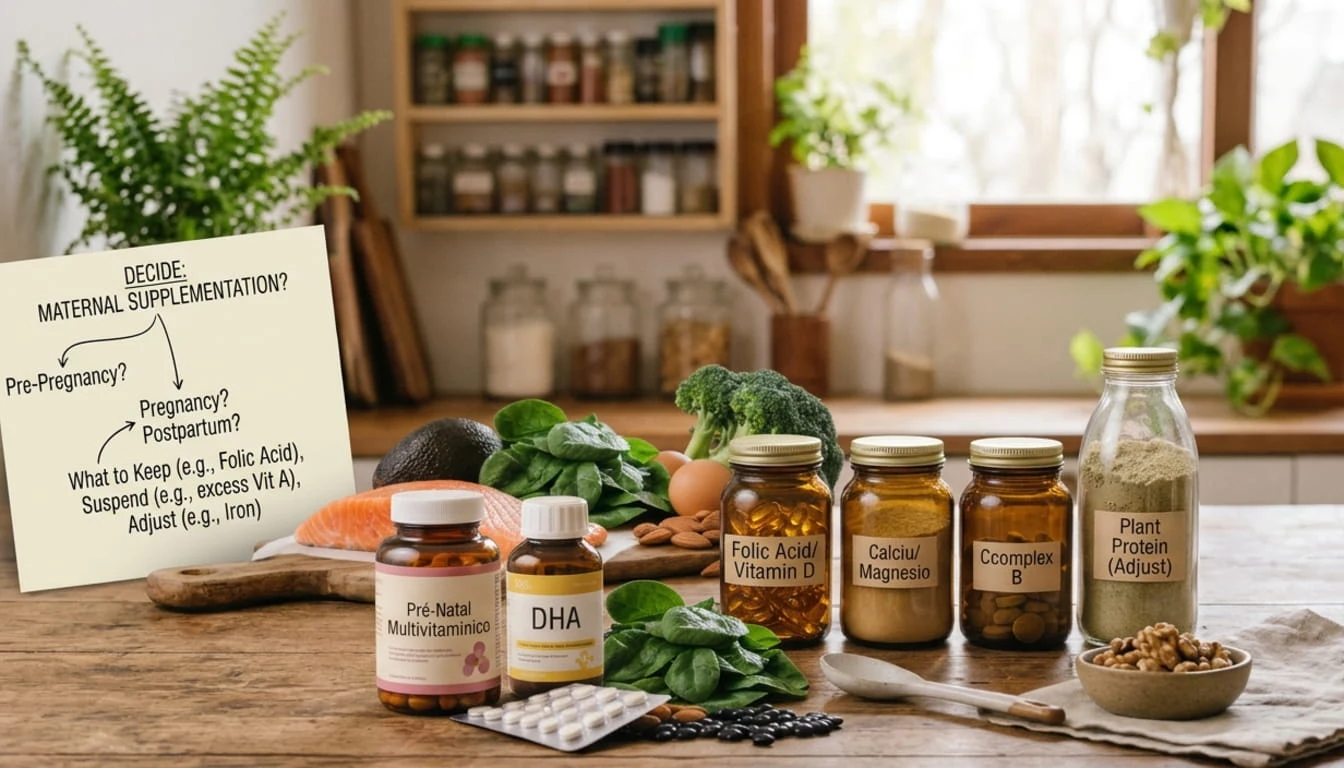
If you already take supplements and are planning pregnancy (or have a positive test), priorities change: safety first, proven benefits second. This guide summarises, in practical terms, what to continue, what to stop and what to adjust in dose before, during and after pregnancy — with clear notes on when to speak to your clinician.
Quick safety principles (how to think about supplements in this phase)
- Prefer supplements with clear, evidence-based roles in pregnancy (e.g. folic acid/folate, iodine, iron, vitamin D, choline, omega-3 DHA). “Energy” products, calming herbal blends and adaptogens should wait.
- Avoid duplications: two multivitamins can add up to high intakes (particular risk with preformed vitamin A, retinol). (acog.org)
- Follow pregnancy/lactation recommended intakes and avoid exceeding tolerable upper limits (UL) unless clinically indicated (e.g. treating iron deficiency). (ods.od.nih.gov)
- Check with your doctor/pharmacist if you take prescription drugs (e.g. antidepressants), have thyroid disease, known anaemia, follow a vegan/vegetarian diet or have a family history of neural tube defects — recommendations may change. (acog.org)
What to continue, stop and adjust — practical overview
| Supplement | Preconception | Pregnancy | Breastfeeding | Key notes |
|---|---|---|---|---|
| Multivitamin/prenatal with folate (400–800 mcg) | Continue | Continue | Can continue | Start at least 1 month before conception. High neural tube defect (NTD) risk may require 4 mg/day (separate pill) for 3 months before and through the 1st trimester. ([acog.org](https://www.acog.org/womens-health/faqs/good-health-before-pregnancy-prepregnancy-care)) |
| Iodine (150 mcg/day in supplement) | Continue | Continue | Continue | Target total daily iodine: ~220 mcg during pregnancy and ~290 mcg while breastfeeding. Avoid excess (>500 mcg/day). ([pmc.ncbi.nlm.nih.gov](https://pmc.ncbi.nlm.nih.gov/articles/PMC3472679/)) |
| Choline (AI 450 mg/day pregnancy; 550 mg/day lactation) | Consider | Continue | Continue | Many prenatal formulas have little or no choline; may need dietary adjustment or a specific supplement. ([ods.od.nih.gov](https://ods.od.nih.gov/factsheets/Pregnancy-HealthProfessional/)) |
| Omega‑3 (DHA 200–300 mg/day) | Continue | Continue | Continue | Prefer low-mercury fish 2–3×/week or fish/algal oil supplements. ([fda.gov](https://www.fda.gov/food/consumers/questions-answers-fdaepa-advice-about-eating-fish-those-who-might-become-or-are-pregnant-or)) |
| Vitamin D (600 IU/day as reference) | Continue | Continue | Continue | Adjust based on blood tests if deficiency is suspected; do not exceed UL 4,000 IU/day without medical indication. Infant who is breastfed needs 400 IU/day. ([acog.org](https://www.acog.org/clinical/clinical-guidance/committee-opinion/articles/2011/07/vitamin-d-screening-and-supplementation-during-pregnancy)) |
| Iron | Adjust by tests | Adjust by tests | Review need | RDA 27 mg/day in pregnancy; WHO recommends 30–60 mg/day for prevention. During lactation requirement falls (~9–10 mg/day). Adjust to haemoglobin/ferritin results. ([ods.od.nih.gov](https://ods.od.nih.gov/factsheets/Iron-HealthProfessional/)) |
| Vitamin A (retinol) and fish liver oil | Stop if contains retinol | Avoid high retinol | Avoid high retinol | Use beta‑carotene instead of preformed vitamin A; avoid liver and fish liver oil (teratogenic risk). ([nhs.uk](https://www.nhs.uk/pregnancy/keeping-well/pregnancy-vitamins-and-supplements/)) |
| 5‑HTP | Stop | Avoid | Avoid | No safety data in pregnancy/lactation; theoretical risk with antidepressants (serotonin syndrome). ([medlineplus.awsqa.nlm.nih.gov](https://medlineplus.awsqa.nlm.nih.gov/druginfo/natural/794.html)) |
| Adaptogens (e.g. ashwagandha, rhodiola, ginseng) | Stop | Avoid | Avoid | Insufficient safety data or specific advisories to avoid. ([nccih.nih.gov](https://www.nccih.nih.gov/health/ashwagandha?nav=tw)) |
Prenatal multivitamin and folic acid/folate: when to start and how much to take
The most important supplement to start early is folic acid/folate. For women without risk factors, 400 mcg/day should begin at least 1 month before conception and continue through the first trimester. If there has been a prior pregnancy affected by a neural tube defect or if you have epilepsy treated with antiepileptic drugs, the typical recommendation is 4 mg/day of folic acid (separate from a multivitamin) for 3 months before conception and during the first trimester, adjusted by your clinician. (acog.org)
Many prenatal multivitamins include 400–800 mcg of folate and other micronutrients (iron, iodine, B vitamins). Always check the label and avoid duplicating products. (acog.org)
Iodine: a small detail with big impact on maternal and fetal thyroid function
Iodine supports thyroid hormone production and fetal neurological development. In the US and in many international guidelines, women planning pregnancy, who are pregnant or breastfeeding are advised to take 150 mcg of iodine daily in a supplement (ideally started 3 months before conception) to reach a total daily intake of about 220 mcg in pregnancy and 290 mcg while breastfeeding. Avoid very high intakes (e.g. >500 mcg/day). (thyroid.org)
Not all prenatal vitamins contain iodine. Look for 150 mcg of iodine (commonly as potassium iodide) on the label. (cdc.gov)
Choline: often missing from prenatals
Choline matters for brain development. Adequate intake (AI) is 450 mg/day during pregnancy and 550 mg/day while breastfeeding. Because many prenatals contain little or no choline, ensure intake through diet (eggs, legumes) or consider a specific supplement if needed. (ods.od.nih.gov)
Omega‑3 (DHA/EPA): how much and where to get it
Most guidance targets 200–300 mg/day of DHA (often framed as a practical goal within ≥250 mg/day of combined DHA+EPA). If you do not eat fatty fish 2–3 times/week, a fish oil or algal oil supplement is a simple alternative. (ods.od.nih.gov)
When choosing fish, follow FDA/EPA advice for pregnant and breastfeeding people: 2–3 servings/week of “Best Choices” (servings ~4 oz/113 g), avoiding species high in mercury (e.g. swordfish, shark, king mackerel). (fda.gov)
Vitamin D: keep it within the right range (and consider the infant)
The reference intake in pregnancy is 600 IU/day (15 mcg). Routine universal screening is not universally endorsed, but your clinician may test vitamin D if deficiency is suspected. Do not exceed the UL of 4,000 IU/day without medical indication. (acog.org)
While breastfeeding, continue your usual supplementation. For the breastfed infant, the recommendation is 400 IU/day of vitamin D from early days if exclusively or partially breastfed. (cdc.gov)
Iron: when it’s preventive and when it’s therapeutic
The RDA for iron in pregnancy is 27 mg/day. For population-level prevention, WHO recommends 30–60 mg of elemental iron per day (with 400 mcg folic acid), a strategy associated with lower risk of maternal anaemia and low birth weight. Choice between 30 or 60 mg depends on clinical context and tolerance. (ods.od.nih.gov)
If you already have blood tests, adjust dose based on haemoglobin and ferritin, under medical supervision. High doses (≥45 mg/day elemental iron) increase gastrointestinal side effects (nausea, constipation). During lactation, requirement falls to ~9–10 mg/day unless postpartum anaemia is present. (ods.od.nih.gov)
Vitamin A: why to avoid retinol and liver products
Excess preformed vitamin A (retinol), including fish liver oil and animal liver, is associated with fetal malformations. Practical advice is to avoid supplements containing retinol during pregnancy and prefer dietary beta‑carotene (the safe precursor). Many prenatals already use beta‑carotene instead of retinol. (nhs.uk)
What to stop/avoid: 5‑HTP and adaptogens
5‑HTP
There are no robust safety data for 5‑HTP in pregnancy or lactation. The conservative recommendation is to avoid it. If you are taking antidepressants (SSRIs, MAOIs, tricyclics), combining 5‑HTP carries a theoretical risk of serotonin syndrome — discuss with your clinician. (medlineplus.awsqa.nlm.nih.gov)
Adaptogens (ashwagandha, rhodiola, ginseng) and other potent herbals
Ashwagandha should be avoided in pregnancy and is not recommended while breastfeeding. For rhodiola and ginseng, safety is uncertain and official guidance suggests avoiding them in the absence of data. During this period it is preferable to suspend all adaptogens and centrally active herbals. (nccih.nih.gov)
Breastfeeding: what changes for the mother and what the infant needs
- Continue the prenatal (or an equivalent multivitamin) and ensure 150 mcg/day iodine; total iodine need is higher during lactation (~290 mcg/day). - Choline requirement rises to 550 mg/day. - Continue daily DHA 200–300 mg and follow low‑mercury fish choices. - The breastfed infant needs 400 IU/day vitamin D from early days. - If you follow a strict vegan/vegetarian diet, discuss vitamin B12 with your clinician and assess iodine and choline intake. (cdc.gov)
Practical checklists
Preconception (ideal start ~3 months before)
- Start or confirm a prenatal with 400–800 mcg folate/folic acid. If high NTD risk, discuss 4 mg/day with your clinician. (acog.org)
- Ensure 150 mcg/day iodine in your supplement. (thyroid.org)
- Review diet/routine to reach choline ~450 mg/day (supplement if needed). (ods.od.nih.gov)
- Add DHA (200–300 mg/day) if you don’t eat fatty fish 2–3×/week. (ods.od.nih.gov)
- Confirm vitamin D (600 IU/day baseline) and only adjust if clinically indicated. (acog.org)
- Stop 5‑HTP and adaptogens (ashwagandha, rhodiola, ginseng). (medlineplus.awsqa.nlm.nih.gov)
- If you take antidepressants, antiepileptics or have thyroid disease, schedule a consultation to create a personalised plan. (acog.org)
Pregnancy confirmed
- Continue the prenatal; check that it contains iodine. (cdc.gov)
- Iron: follow your clinician’s advice (reference 27 mg/day; WHO prevention 30–60 mg/day; treat anaemia according to labs). (ods.od.nih.gov)
- Vitamin A: avoid retinol and liver/fish liver oil. (nhs.uk)
- Omega‑3: eat low‑mercury fish 2–3×/week or take a DHA supplement. (fda.gov)
- Vitamin D: maintain ~600 IU/day; do not exceed 4,000 IU/day without indication. (acog.org)
Breastfeeding
- Continue multivitamin/prenatal; ensure iodine 150 mcg/day, choline 550 mg/day and daily DHA. (cdc.gov)
- Infant: 400 IU/day vitamin D from the first days if breastfed. (cdc.gov)
- Avoid adaptogens and 5‑HTP until you finish breastfeeding. (nccih.nih.gov)
When to talk to your clinician (before changing doses)
- Personal or family history of neural tube defects, treated epilepsy, bariatric surgery, inflammatory bowel disease, known anaemia or thyroid disease. (acog.org)
- Use of antidepressants, anxiolytics, mood stabilisers or herbal products acting on the central nervous system (e.g. 5‑HTP, St John’s wort). (mskcc.org)
- Strict vegan/vegetarian diet (plan for B12 and iodine; evaluate choline). (cdc.gov)
Sources
- Good Health Before Pregnancy: Prepregnancy Care | ACOG — /folato pré‑concepção e alto risco
- Folic Acid — Sources and Recommended Intake | CDC — 400 mcg/d para todas as mulheres em idade fértil
- Dietary Supplements and Life Stages: Pregnancy — ODS/NIH — panorâmica de micronutrientes (colina, ferro, vitamina D, peixe/DHA, ULs)
- Omega‑3 Fatty Acids — Health Professional Fact Sheet | ODS/NIH — metas de DHA/EPA na gravidez
- FDA/EPA — Questions & Answers about Eating Fish for Those Who Might Become or Are Pregnant or Breastfeeding — 2–3 porções/semana e escolhas com baixo mercúrio
- Vitamin D: Screening and Supplementation During Pregnancy | ACOG — 600 IU/d e postura sobre rastreio
- Vitamin D and Breastfeeding | CDC — 400 IU/d para bebés amamentados
- Daily iron and folic acid supplementation during pregnancy | WHO eLENA — 30–60 mg/d de ferro elementar + 400 mcg de ácido fólico (prevenção)
- Iron — Health Professional Fact Sheet | ODS/NIH — RDA 27 mg/d; UL 45 mg/d; efeitos GI em altas doses
- Iodine and Breastfeeding | CDC — 150 mcg/d de iodo no suplemento e necessidades na lactação
- Hypothyroidism in Pregnancy | American Thyroid Association — ATA: 150 mcg/d de iodo no suplemento; meta ~250 mcg/d na gravidez
- Choline — Health Professional Fact Sheet | ODS/NIH — AI 450 mg/d (gravidez) e 550 mg/d (amamentação)
- Pregnancy vitamins and supplements | NHS — evitar vitamina A (retinol), fígado e óleo de fígado de peixe
- Ashwagandha: Usefulness and Safety | NCCIH — evitar na gravidez e amamentação
- Rhodiola: Usefulness and Safety | NCCIH — segurança desconhecida; evitar na gravidez/amamentação
- 5‑HTP: MedlinePlus Supplements — evitar 5‑HTP na gravidez/amamentação (falta de dados)
- 5‑HTP | Memorial Sloan Kettering — Herbal monograph — risco de interações (ISRS/IMAO) e síndrome serotoninérgica
- Healthy Eating During Pregnancy | ACOG
- Prepregnancy Counseling | ACOG
- Guidelines of the American Thyroid Association for the Diagnosis and Management of Thyroid Disease During Pregnancy and Postpartum
- Reducing Risks of Birth Defects | ACOG
- Maternal Diet and Breastfeeding | Breastfeeding special circumstances | CDC
Sources listed by the authors. Always confirm information with a healthcare professional.